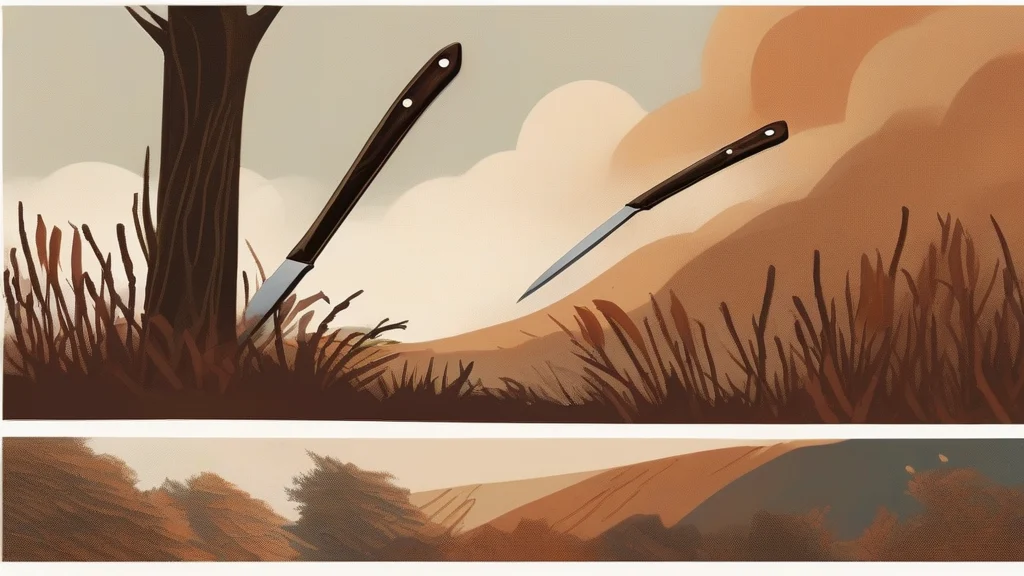
What does billhook mean?
A billhook is a hand tool consisting of a short handle attached to a heavy, broad blade that curves toward the tip, often ending in a pronounced hook. Designed primarily for cutting wood rather than soft vegetation, it is used to prune trees, chop branches, split stakes, and — most famously — lay hedges, a traditional craft in which living stems are partly cut and bent to form dense livestock barriers. The billhook has been a staple of European farming for centuries, and regional variations in blade shape developed across Britain and continental Europe. Today the word appears mainly in agricultural, forestry, and historical writing, evoking a rural world of hedgerows and hand tools. Though power tools have displaced it in much commercial work, it remains valued by practitioners of traditional hedge-laying and woodland crafts.
nounA heavy knife or short-handled cutting tool with a hooked, often curved blade, used chiefly for pruning, hedging, and chopping small branches.
- A short-handled cutting tool with a curved or hooked blade, used in agriculture and forestry for pruning, lopping, and hedge-laying.
"The hedge-layer trimmed the shoots cleanly with his well-worn billhook."
"He cleared the overgrown brambles with a single swing of the billhook."
"In the shed hung an assortment of tools — shears, a saw, and a rusty old billhook."
Standard regular plural.
"The workshop displayed billhooks of several different regional patterns."
The billhook has been shaping Europe's hedgerows for centuries — and it's still the tool traditional hedge-layers refuse to replace.
Reviewed by Deb Chak, Editor. AI-assisted content curated by RJS Tech Solutions LLP.
Etymology of billhook
The word billhook combines 'bill', from Old English 'bil', meaning a cutting tool or sword-like weapon, with 'hook', describing its curved blade. The element 'bill' is of Germanic origin and also survives in the name of the medieval polearm known as the bill. The compound itself became established in English by around the sixteenth century.
How billhook is actually used
The word carries rural, traditional connotations and appears mostly in agricultural, gardening, and historical contexts rather than everyday conversation.
Easily confused with billhook
A sickle has a long, crescent-shaped blade on a short handle for reaping grain, while a billhook has a shorter, broader blade with a hook at the tip for cutting woody stems and branches.