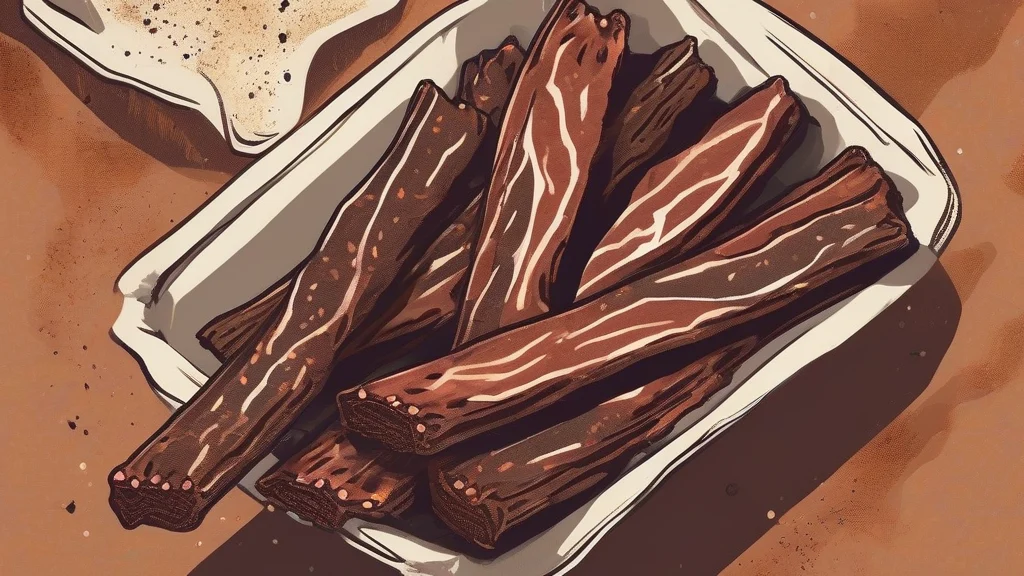
What does biltong mean?
Biltong is a traditional southern African food consisting of strips of meat — most commonly beef, but also game such as kudu or springbok — that are marinated in vinegar, rubbed with salt, pepper, and crushed coriander seed, and then air-dried until firm. Unlike American jerky, biltong is generally not smoked or cooked with heat, and its strips are often cut thicker, leaving the interior moist and tender rather than uniformly dry. Eaten as a high-protein snack, it is deeply embedded in South African culture, sold everywhere from butcheries and supermarkets to roadside stalls, and shared at sports grounds and on journeys. The word entered English from Afrikaans during the colonial era and is now recognised internationally wherever South African communities have settled. For travellers to the region, tasting good biltong is considered something of a rite of passage, and homemade versions are a point of pride passed down through families.
nounA Southern African food of strips of meat (usually beef or game) that are salted, spiced with coriander and other seasonings, and air-dried; eaten as a snack. The word also refers to the meat itself once prepared in this way.
- Strips of salted, spiced, air-dried meat, typically beef or game, eaten as a snack in southern Africa.
- The prepared meat itself regarded as a foodstuff or commodity.
"She packed a bag of biltong for the long road trip across the Karoo."
"He sliced the biltong thinly and shared it around the campfire."
"The butcher's window was filled with droëwors, boerewors, and slabs of dark biltong."
Most often used as an uncountable noun; the plural 'biltongs' appears mainly in reference to different kinds or batches.
"The stall offered several biltongs — beef, ostrich, and springbok."
Biltong was born out of necessity — Dutch settlers needed meat that could survive months without refrigeration on treks across southern Africa.
Reviewed by Deb Chak, Editor. AI-assisted content curated by RJS Tech Solutions LLP.
Etymology of biltong
Biltong derives from Dutch 'bil', meaning buttock or haunch, and 'tong', meaning tongue or strip — together referring originally to the cured rump of an animal. The word passed into Afrikaans and from there into South African English during the period of Dutch settlement at the Cape. Its cognates lie within Dutch and Afrikaans vocabulary built on the same two roots, such as 'bil' and 'tong' themselves.
How biltong is actually used
The word is strongly associated with South Africa and is used with mass-noun-like behaviour in many contexts ('some biltong', 'a piece of biltong'), though an English-style plural 'biltongs' also occurs when referring to different types. It carries warm cultural connotations for South Africans, evoking rugby matches, road trips, and family recipes.
Easily confused with biltong
Jerky is a broader term for dried marinated meat of any origin, while biltong specifically refers to the South African style cured with vinegar, salt, and coriander and typically dried in thicker strips without smoking.