What does charqui mean?
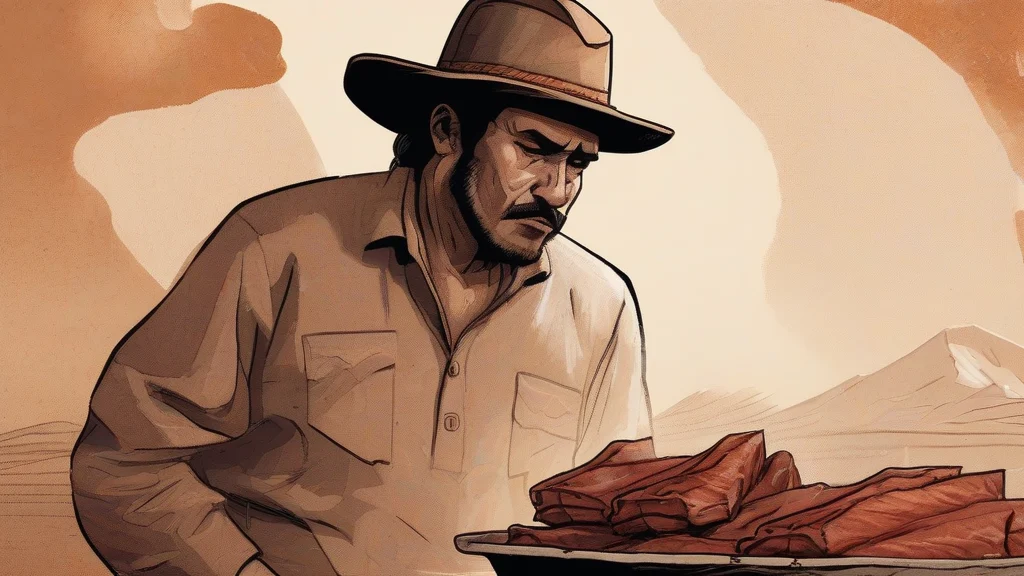
Charqui is a noun denoting meat — most often beef — that has been sliced into strips, heavily salted, and dried in the open air to preserve it. The technique long predates refrigeration and remains part of traditional food culture in Argentina, Chile, Peru, and neighbouring countries, where it sustained gauchos, soldiers, and travellers on long journeys. In flavour and preparation it closely resembles what North Americans call jerky, and indeed the English word 'jerky' is itself derived from 'charqui'. The word entered European languages via Spanish from Quechua, the major indigenous language of the Andes, making it one of many loanwords that trace the colonial history of South America. Today it is encountered mainly in historical, culinary, and regional contexts rather than casual conversation.
nounDried, salted strips of meat, especially beef, prepared in a manner traditional to South America and comparable to North American jerky.
- Meat, typically beef, that has been cut into strips, salted, and dried in the sun or wind for preservation, as traditionally made in South America.
"The gauchos carried charqui and hard biscuits on their long rides across the pampas."
"Supplies of charqui kept the expedition fed through the winter months when fresh meat was impossible to obtain."
"In the markets of Salta, vendors still sell hand-cut charqui alongside local cheeses."
Usually treated as uncountable ('some charqui'); a plural is rare and generally found in older or trade-related texts.
"Casks of charquis were loaded onto the ship at Buenos Aires."
Every bag of jerky you've ever eaten owes its name to 'charqui', a word the English borrowed from the Quechua language of the Andes.
Reviewed by Deb Chak, Editor. AI-assisted content curated by RJS Tech Solutions LLP.
Etymology of charqui
Charqui comes from Spanish, which borrowed it from Quechua 'ch'arki', the indigenous Andean term for dried meat. It was adopted into English during the period of Spanish American trade and exploration, when salted South American beef was shipped abroad. Its most notable English descendant is 'jerky', which developed as an alteration of 'charqui' and eventually became the standard English word for dried meat strips.
How charqui is actually used
The term is uncommon in everyday British and American English, where 'jerky' dominates. It appears most often in historical writing about South America, in discussions of gaucho or Andean foodways, and in trade contexts.
Easily confused with charqui
Jerky is the English word derived from 'charqui' and now refers broadly to any dried meat strip, while charqui specifically denotes the South American style of salted, air-dried beef.