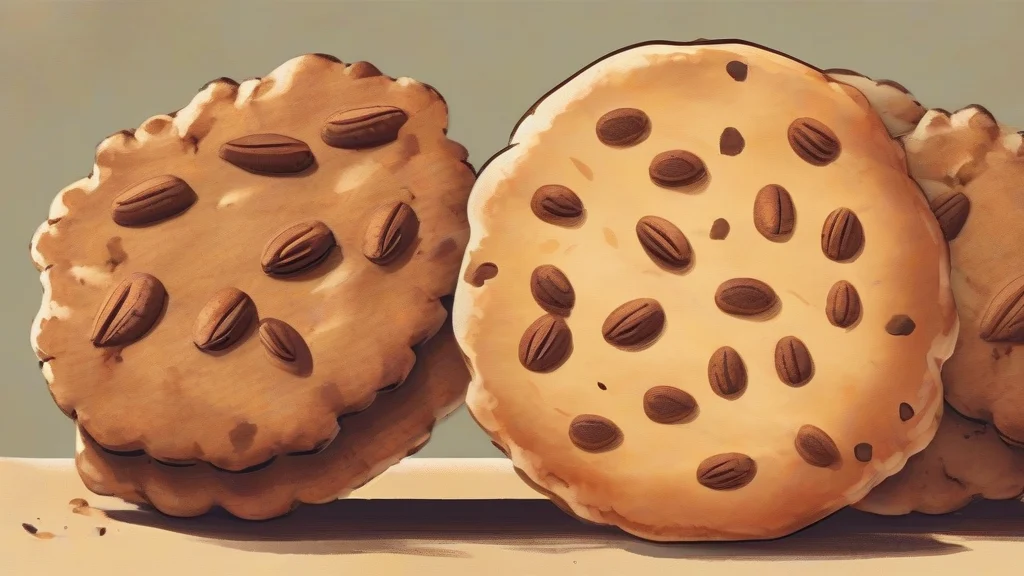
What does biscotto mean?
A biscotto is a single crisp Italian cookie, traditionally flavoured with almonds and baked twice to give it a dry, crunchy texture ideal for dunking in coffee or dessert wine. It is the singular form of 'biscotti', a word that has entered everyday English largely through café menus and Italian bakeries. In practice, many English speakers say 'a biscotti', but strictly speaking 'biscotti' is plural, and 'biscotto' is the correct term for one cookie alone. The name comes from the Latin phrase meaning 'twice-cooked', the same baking technique that produced the ancestors of modern biscuits. The word evokes Italian hospitality — the ritual of dipping a hard, nutty cookie into espresso or Vin Santo — and it remains most at home in culinary contexts rather than general conversation about sweets.
nounA single crisp Italian cookie, typically almond-flavoured and twice-baked; the singular form of 'biscotti'.
- A single crisp, twice-baked Italian cookie, typically containing almonds or other nuts.
"She dunked a biscotto into her espresso until it softened just enough."
"He reached for the last biscotto on the plate beside his cappuccino."
"The bakery sells each biscotto individually wrapped so they stay perfectly crisp."
In Italian, 'biscotti' is simply the plural of 'biscotto'; in English it is sometimes treated as a mass noun or even singular, though purists keep the two forms distinct.
"She baked three batches of biscotti for the holiday market."
Ordering 'a biscotti' at a café is a classic blunder — 'biscotti' already means 'more than one', so one cookie is always a 'biscotto'.
Reviewed by Deb Chak, Editor. AI-assisted content curated by RJS Tech Solutions LLP.
Etymology of biscotto
The word 'biscotto' derives from Italian, formed from the Latin elements 'bis' (twice) and 'coctus' (cooked), literally meaning 'twice-baked' — a reference to the traditional method of baking the dough once in loaves, slicing it, then toasting the slices until dry and crisp. The same Latin construction underlies the English word 'biscuit'. The singular 'biscotto' and its plural 'biscotti' entered English through Italian cuisine, with the plural becoming the more familiar form outside Italy.
Related word forms
How biscotto is actually used
In English usage, 'biscotti' is far more common than its singular 'biscotto' and is frequently treated as both singular and plural, though careful speakers reserve 'biscotto' for one cookie. The word carries an Italian café-culture connotation and is most natural when discussing Italian food specifically; for general cookies, plain 'cookie' or 'biscuit' is preferred.
Easily confused with biscotto
'Biscotti' is the Italian plural referring to multiple cookies, while 'biscotto' is the singular for just one — English speakers often mistakenly use 'biscotti' as a singular.