
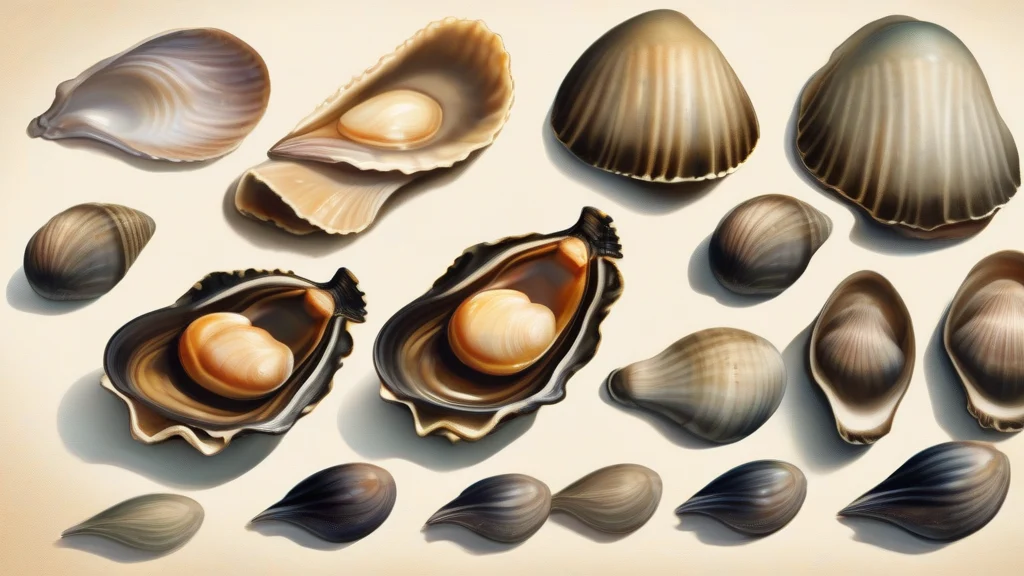
What does bivalve mean?
A bivalve is any mollusc belonging to the class Bivalvia, characterised by a soft body enclosed within a shell composed of two halves — called valves — joined along a flexible hinge. Familiar examples include oysters, clams, mussels, and scallops, many of which are harvested for food. Most bivalves live in aquatic environments, where they feed by filtering small particles from the water. The word can also function adjectivally to describe anything constructed of two hinged or matching parts, though this sense occurs mainly in technical contexts. Because bivalves are economically important both as seafood and as filter-feeders that improve water quality, the term appears frequently in marine biology, ecology, and gastronomy alike.
A mollusc of the class Bivalvia, having a soft body enclosed in a shell of two hinged halves.
"The reef supported dense beds of bivalves that filtered vast quantities of seawater daily."
Having or consisting of a shell or structure of two hinged or movable parts.
"Brachiopods have a bivalve shell arrangement, yet they are not closely related to true bivalves."
The plural follows the standard English -s pattern. When referring to the class collectively, scientists often use the capitalized form Bivalvia.
"Ancient middens show that coastal peoples harvested bivalves for thousands of years."
Oysters, clams, and mussels are all members of class Bivalvia — a group whose name literally means 'two doors', because each half of their shell opens like a pair of hinged gates.
Reviewed by Deb Chak, Editor. AI-assisted content curated by RJS Tech Solutions LLP.
Etymology of bivalve
The word "bivalve" derives from New Latin Bivalvia, built on the Latin prefix bi-, meaning "two", and valva, meaning the leaf or folding section of a door. It entered English usage in the seventeenth century as naturalists began systematically classifying shelled animals. It shares its prefix with words such as "bicameral" and "bilingual", and its second element with "valve", which comes from the same Latin noun.
How bivalve is actually used
"Bivalve" is primarily used in zoology and in culinary contexts; it is largely synonymous with "bivalve mollusc" but excludes other shelled seafood such as crustaceans. As an adjective it appears mostly in scientific writing.
Easily confused with bivalve
An univalve has a single-piece shell (like a snail), whereas a bivalve has a shell made of two hinged parts.