What does calve mean?
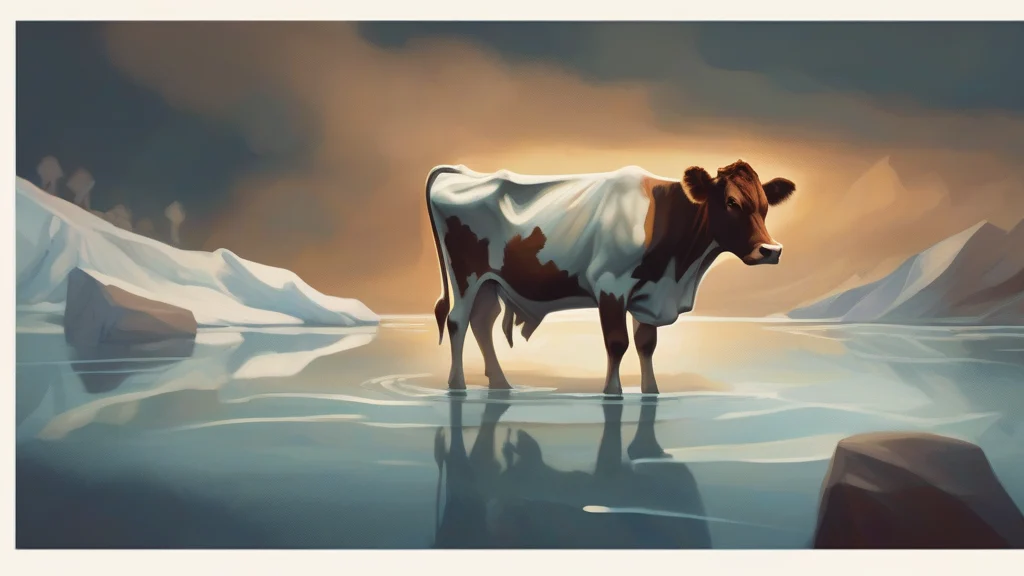
To calve is to give birth to a calf — most commonly said of cows, but applied equally to whales, seals, elephants, and other large mammals whose young are called calves. The verb is central to farming vocabulary: ranchers speak of calving season, plan breeding so that cows calve at favorable times of year, and monitor difficult births closely. Strikingly, the same verb acquired a second life describing glaciers: when a chunk of ice breaks away from a glacier's edge or an ice shelf, the glacier is said to 'calve', producing icebergs. This glacial sense dates from the nineteenth century and has become especially prominent in reporting on climate change and polar science. The word descends from Old English 'cealfian', tied to 'cealf' (calf), and shares Germanic roots with Dutch 'kalf' and German 'Kalb'. Whether on the farm or at the ice front, 'calve' conveys the image of something new and substantial separating from its parent body.
verb(of a cow or other large mammal) to give birth to a calf; also used of glaciers and icebergs meaning to break off a mass of ice.
- When a cow, whale, elephant, or other large mammal gives birth to a calf.
- When a glacier or iceberg breaks apart and sheds a mass of ice.
"The herd will begin to calve in early spring, when the cows are moved to the sheltered paddocks."
"Most of the cows in the herd calve in late winter, so farmers keep a close watch through February."
"Tourists gathered to watch the tidewater glacier calve, sending house-sized blocks of ice thundering into the bay."
The same word that describes a cow giving birth also describes a glacier shedding a chunk of ice the size of Manhattan — one verb for both barnyard and iceberg.
Reviewed by Deb Chak, Editor. AI-assisted content curated by RJS Tech Solutions LLP.
Etymology of calve
Calve derives from Old English 'cealfian', formed on 'cealf' (calf), which traces back through Proto-Germanic '*kalbaz' — making it a true cognate of Dutch 'kalf' and German 'Kalb'. The word has been used for the birthing of cattle since the earliest stages of English. Its application to glaciers breaking off masses of ice arose in the nineteenth century, likely by analogy between a cow dropping her calf and a glacier dropping a berg.
Related word forms
How calve is actually used
Primarily used of cattle in farming contexts; extended figuratively to whales, seals, elephants, and — since roughly the 19th century — to glacial ice. In American usage 'calve' can take 'calf' as an object ('she calved a fine heifer'), though this is less common elsewhere.
Easily confused with calve
'Calf' names the young animal itself, while 'calve' is the verb describing the act of giving birth to that animal.