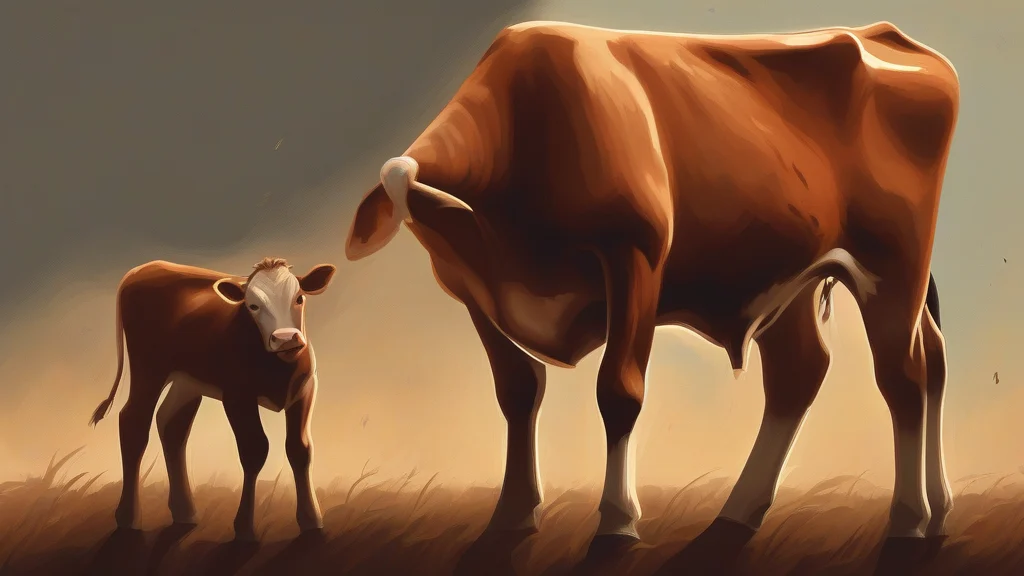
What does calved mean?
"Calved" is the past tense and past participle of the verb "calve," which carries two distinct but related meanings. In its oldest sense, it describes a cow or other large mammal giving birth to a calf — standard vocabulary among farmers, veterinarians, and anyone working with livestock. By extension, it is now firmly established in glaciology, where a glacier is said to have calved when a mass of ice breaks away from its front to form an iceberg, a process central to discussions of melting ice sheets and rising seas. The word comes from Old Norse, entering English through contact with Scandinavian settlers, and it remains in regular use on both sides of the Atlantic. Its two senses share a pleasing symmetry: both describe something new and separate coming into the world.
verb"Calved" is the past tense and past participle of "calve," meaning to give birth to a calf (of a cow or other large mammal) or, by extension, to break off a mass of ice such as an iceberg from a glacier.
- To give birth to a calf (of cattle or other mammals).
- (Of a glacier or iceberg) to break off or shed a mass of ice.
"The massive berg calved from the Greenland ice sheet with a thunderous crack."
"The heifer calved without difficulty during the night."
"A chunk of ice the size of Manhattan calved off the Larsen shelf in 2017."
The same verb that describes a cow giving birth also describes glaciers shedding icebergs — English borrowed it from the Vikings and let it do double duty.
Reviewed by Deb Chak, Editor. AI-assisted content curated by RJS Tech Solutions LLP.
Etymology of calved
"Calved" derives from the verb "calve," which comes from Old Norse "kálfa," related to the noun "kalfr" meaning calf. The corresponding Old English form was influenced heavily by Scandinavian settlement, and the verb has been part of English since the medieval period. It shares its Germanic root with Dutch "kalf" and German "Kalb." The extended sense applied to glaciers breaking off ice developed later but is now fully established.
Related word forms
How calved is actually used
Primarily used of cattle in agricultural contexts; the glaciological sense is well established in scientific journalism and climate reporting.
Easily confused with calved
"Carved" means cut or shaped material, while "calved" refers to a animal giving birth to a calf or ice breaking off a glacier.