What does calving mean?
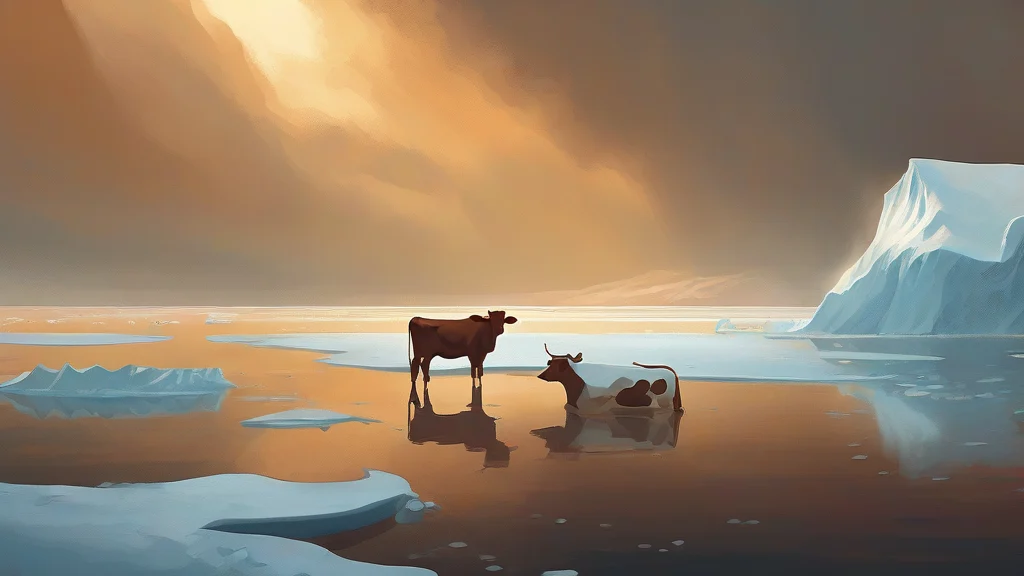
Calving is a noun with two distinct but related uses. In agriculture, it describes the act of a cow — or occasionally another large mammal, such as a whale — giving birth to a calf, and the term is central to livestock management, where 'calving season' marks one of the busiest and most demanding periods of the farming year. In glaciology, calving refers to the dramatic moment when a block of ice breaks away from a glacier's edge, an ice shelf, or an iceberg, plunging into water to form a new floating mass known, fittingly, as an ice calf. This second sense has taken on particular weight in recent decades, as increased calving rates at Greenland and Antarctic glaciers are widely reported as visible indicators of climate change. The word derives from Old English cealfian, meaning to bear a calf, tying both senses back to the same ancient image: something new and heavy being brought into the world.
The act of a cow or other animal giving birth to a calf.
"The vet stayed overnight during the difficult calving."
Most commonly associated with cattle, but also applied to whales and other large mammals.
The breaking away of a mass of ice from a glacier, ice shelf, or iceberg.
"A massive calving sent waves across the fjord."
Standard technical term in glaciology.
The plural 'calvings' is attested mainly in agricultural writing referring to multiple birth events, and occasionally in glaciology.
"The farm recorded several difficult calvings that spring."
Glaciers don't just melt — they give birth, and scientists literally call each newborn chunk of ice a 'calf'.
Reviewed by Deb Chak, Editor. AI-assisted content curated by RJS Tech Solutions LLP.
Etymology of calving
Calving derives from the verb calve, which comes from Old English cealfian, formed from cealf ('calf'). The noun ultimately traces back to the Proto-Germanic root *kalb-, which also gives German Kalb and Dutch kalf. The glaciological use developed by extension: when a mass of ice separates from a glacier, it was likened to a cow bringing forth her calf, so the resulting floe became known as an 'iceberg calf' and the event as calving.
Related word forms
How calving is actually used
In farming contexts the word carries practical, sometimes anxious connotations, since calving can involve difficult births requiring assistance. In glaciology it is a neutral technical term and has become more prominent in public discussion because of its link to climate change and ice loss.
Easily confused with calving
Carving means cutting or shaping material such as wood or stone, whereas calving refers to an animal bearing young or ice breaking off a glacier.