
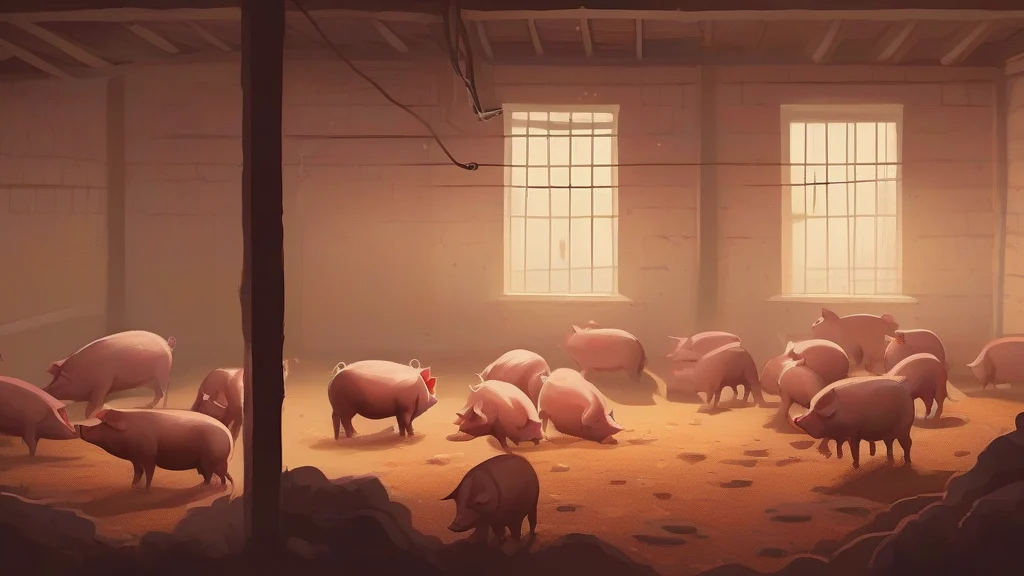
What does farrow mean?
Farrow is an agricultural term used almost exclusively of pigs: as a verb, it means that a sow has given birth to a litter of piglets, and as a noun it refers to the litter itself. A farmer might say a sow 'will farrow next week', or speak of preparing a farrowing pen ahead of the birth. The word carries no emotional charge beyond its practical, husbandry associations — it belongs firmly to the vocabulary of livestock farming and veterinary science rather than everyday speech. Its origins reach back to Old English, where it denoted a young pig or a litter, and it remains standard in both Britain and North America wherever pigs are raised commercially. Though easily confused by ear with 'furrow' — the trench cut by a plough — the two words are entirely distinct in origin and meaning. For anyone working around swine, farrow is an indispensable piece of terminology.
Of a sow: to give birth to a litter of pigs.
"The sow is expected to farrow before the end of the month."
Almost always used in agricultural, breeding, or veterinary contexts.
A litter of piglets.
"A farrow of ten piglets was recorded in the barn log."
This noun sense is now less common than the verb.
The plural applies to the noun sense (a litter of pigs) and is rare outside specialist farming literature.
"The records listed several successful farrows across the spring season."
"Farrow" has nothing to do with farming arrows or ploughed fields — it's the age-old word for a sow giving birth to her piglets.
Reviewed by Deb Chak, Editor. AI-assisted content curated by RJS Tech Solutions LLP.
Etymology of farrow
Farrow descends from Old English 'fearr', a term for a young pig or a brood of pigs, making it a genuinely ancient survivor of English agricultural vocabulary. From this noun was derived the verb sense of giving birth to a litter, which became the dominant modern usage. The name of the word is unrelated to 'furrow', despite the superficial similarity in sound.
How farrow is actually used
Farrow is chiefly an agricultural and veterinary term, common in pig-farming contexts but rare in everyday conversation. The verb is the dominant sense in modern usage; the noun sense (a litter of pigs) survives mainly in older and specialist literature.
Easily confused with farrow
A furrow is a long trench made in the ground by a plough, whereas farrow refers to the birth of a litter of pigs or to that litter itself.