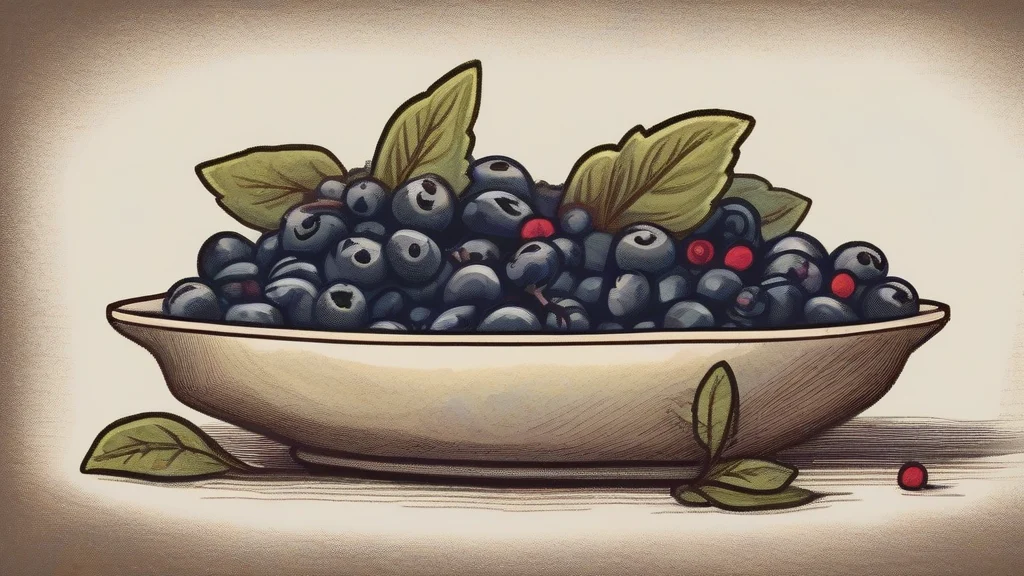
What does blaeberry mean?
A blaeberry is the small, dark-blue, sweet-tart fruit of the bilberry shrub (Vaccinium myrtillus), known by this name mainly in Scotland and northern England. The berries grow wild on acidic moorland and upland heaths, ripening in late summer, and have long been gathered by hand for eating fresh or making into jams, jellies, pies, and puddings. Smaller and more intensely flavored than the cultivated blueberry, the blaeberry holds a cherished place in regional food culture, evoking childhood memories of foraging among the heather. Because the word is dialectal rather than standard, it carries warm, rustic connotations and signals local identity; outside its home region, readers are more likely to encounter 'bilberry', which refers to exactly the same plant and fruit.
nounA blaeberry is the small, edible dark-blue fruit of the bilberry plant (Vaccinium myrtillus), gathered wild on moors and hillsides; it is chiefly a Scottish and Northern English name for what is elsewhere called the bilberry.
- The small edible dark-blue berry of the bilberry (Vaccinium myrtillus), picked wild in Scotland and northern England.
"We spent the August afternoon picking blaeberrries on the hillside above the glen."
"The children came home with purple-stained fingers after an hour gathering blaeberrries among the heather."
"Her grandmother's blaeberry jam, made each summer from berries picked on the Perthshire hills, was legendary in the village."
Standard plural, formed by adding -es; often treated as a mass noun when referring to the gathered fruit.
"She simmered the blaeberrries slowly with sugar to make a deep-purple preserve."
The 'blae' in blaeberry comes straight from Old Norse for 'blue' — a Viking-era word that still survives on Scottish hillsides every berry-picking season.
Reviewed by Deb Chak, Editor. AI-assisted content curated by RJS Tech Solutions LLP.
Etymology of blaeberry
The first element, 'blae', derives from Old Norse 'blár', meaning 'blue', reflecting the Scandinavian influence on northern British vocabulary; it survives in Scots meaning a dark blue-black or leaden color. It was combined with 'berry' to name the dark-blue fruit of Vaccinium myrtillus. Related Germanic color words include 'blue' itself and, more distantly, 'black'.
How blaeberry is actually used
The word is regional and somewhat traditional, carrying rustic, nostalgic connotations of hillside foraging in Scotland and northern England. In most other varieties of English, including standard American English, 'bilberry' or 'blueberry' would be used instead.
Easily confused with blaeberry
Bilberry is the standard British name for the same fruit and plant; 'blaeberry' is simply its regional Scottish and Northern English equivalent.
Blueberries are larger cultivated American fruits (Vaccinium sect. Cyanococcus), whereas blaeberrries are smaller, wilder, darker European bilberries.