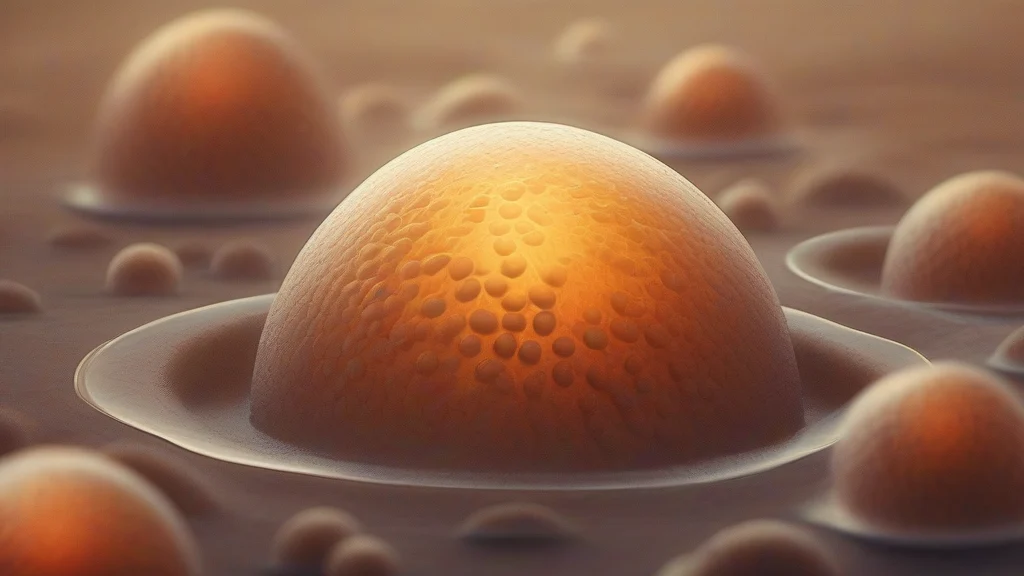
What does blastocyst mean?
A blastocyst is the structure formed in the very earliest stages of mammalian development, typically five to six days after an egg is fertilized. By this point, the dividing embryo has become a hollow sphere: an outer layer of cells called the trophoblast, which will go on to help form the placenta, surrounds a cluster of cells known as the inner cell mass, which gives rise to the embryo proper. The term belongs chiefly to embryology, developmental biology, and reproductive medicine, where it is central to in vitro fertilization — clinics often grow embryos to the blastocyst stage before transfer or freezing because survival prospects can be better assessed at that point. Though technical rather than everyday vocabulary, the word carries considerable significance in public debates over stem-cell research and fertility treatment, since the blastocyst marks the stage at which embryonic stem cells may be harvested.
nounA blastocyst is a hollow ball of cells that forms in early mammalian development about five to six days after fertilization, consisting of an outer layer of cells destined to form the placenta and an inner cell mass that develops into the embryo.
- A mammalian embryo at the stage of development (roughly five days after fertilization) when it forms a hollow sphere with an outer trophoblast and an inner cell mass.
"The embryo reached the blastocyst stage on day five, making it ready for transfer during IVF."
"Only blastocysts of good quality are typically selected for frozen storage."
"Researchers cultured the cells from the inner cell mass of the mouse blastocyst."
Standard English plural; used routinely in clinical and research writing.
"Several viable blastocysts were cryopreserved for later transfer."
Every human being once spent about two days as a blastocyst — a microscopic hollow sphere smaller than a grain of salt.
Reviewed by Deb Chak, Editor. AI-assisted content curated by RJS Tech Solutions LLP.
Etymology of blastocyst
Blastocyst was coined in the late nineteenth century from Greek roots: 'blastos', meaning a bud or sprout, and 'kystis', meaning a bladder or sac. It shares these elements with other embryological terms such as blastula and blastoderm, which use the same root for budding growth. The word entered English through the German-language scientific literature of early embryology, reflecting the era's rapid expansion of descriptive terms for developmental stages.
How blastocyst is actually used
Blastocyst is a technical term used almost exclusively in embryology, developmental biology, reproductive medicine, and related scientific writing. It is rarely encountered in general conversation but appears frequently in fertility-clinic contexts such as IVF, where 'day-five' embryos are described at the blastocyst stage.
Easily confused with blastocyst
A blastula is a broader term for the earlier hollow sphere of cells in embryonic development, while the blastocyst is the specific mammalian form of the blastula distinguished by its inner cell mass and fluid-filled cavity.
A morula is a solid ball of cells formed before the blastocyst; it lacks the blastocyst's internal cavity and distinct cell layers.