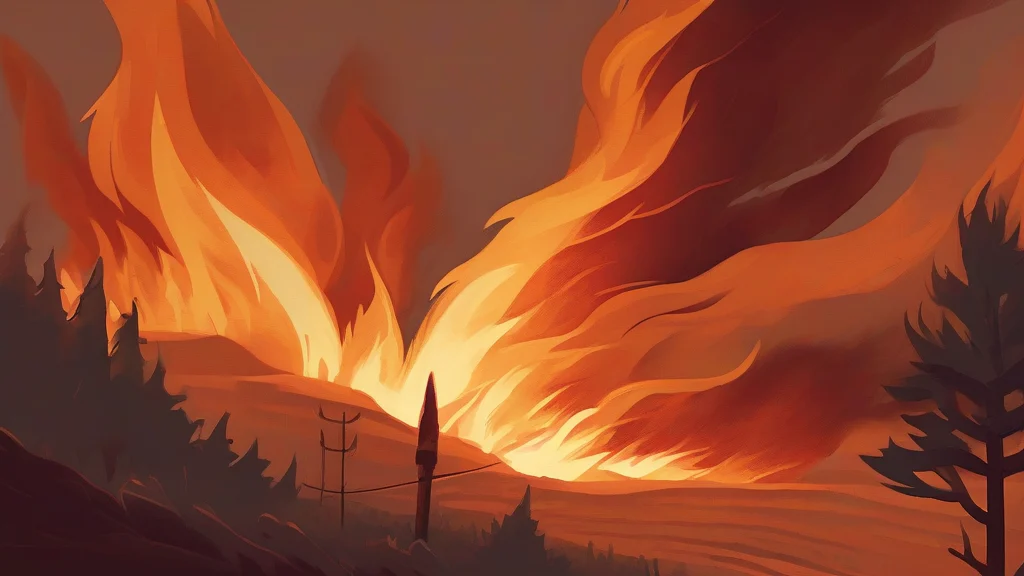
What does blaze mean?
A blaze is a fire of exceptional intensity — one that burns fiercely and throws out bright light and heat, as opposed to a small flame or a smoldering ember. The word is most often heard in news reports about destructive fires, where phrases like 'firefighters tackled the blaze' are standard. Beyond its literal meaning, blaze is richly figurative: a burst of brilliant light can be a blaze of colour, intense media attention a blaze of publicity, and a dramatic end a going-out in a blaze of glory. As a verb, blaze means to burn brightly, to fire weapons repeatedly, or to charge ahead with force — and in the expression 'to blaze a trail,' it refers to the old practice of marking forest routes by cutting blazes into tree bark, from which the modern term 'trailblazer' descends. The word also names the pale stripe running down some horses' faces.
A large, fiercely burning fire producing intense light and heat.
"It took three engines and six hours to bring the warehouse blaze under control."
A brilliant burst or show of light, colour, emotion, or attention.
"The garden erupted in a blaze of tulips each spring."
A broad white stripe running down the middle of an animal's face, especially a horse's.
"The chestnut mare was easy to spot thanks to the wide blaze down her forehead."
In equestrian terminology, a blaze is distinguished from smaller markings such as a star or snip.
To burn fiercely or brightly; to shine with great intensity.
"The bonfire blazed high above the beach as night fell."
The plural is straightforward and regular; 'blazes' also survives in British English as an old-fashioned mild oath, as in 'what the blazes?'
"Several separate blazes broke out across the region during the dry spell."
The word 'trailblazer' literally comes from settlers marking paths by blazing trees — cutting notches in the bark to show the way.
Reviewed by Deb Chak, Editor. AI-assisted content curated by RJS Tech Solutions LLP.
Etymology of blaze
Blaze comes from Old English 'blæse' and 'blæse-bælg' meaning a torch or lamp, from Proto-Germanic *blasón, related to words for glowing embers. The noun denoting a fierce fire was well established by Middle English. The verb developed from the noun, and the sense of marking trees ('blazing a trail') arose in colonial American English in the 18th century, giving us 'trailblazer.' The animal marking sense likely derives from the same image of a bright streak against darkness.
Related word forms
How blaze is actually used
'Blaze' is a neutral-to-vivid word: literal uses appear in everyday news reporting on fires, while figurative uses ('a blaze of glory', 'a blaze of publicity') carry connotations of drama, brilliance, or intensity. The verb sense 'to blaze a trail' has given rise to the noun 'trailblazer' for pioneers in any field. In British English, 'blazes!' is also used as a mild old-fashioned exclamation of surprise or anger.
Easily confused with blaze
To glaze is to coat or cover with a glassy surface (as in pottery or pastry), while to blaze is to burn brightly — the two differ by one letter but share nothing in meaning.
Blaise is a proper noun (a personal name, as in philosopher Blaise Pascal), whereas blaze is a common word for a fierce fire.