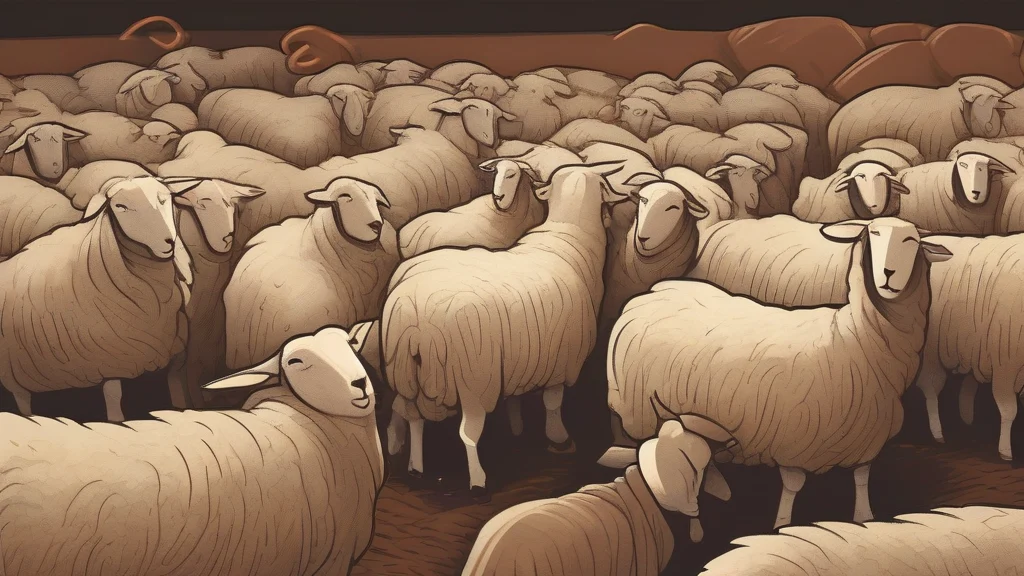
What does bleating mean?
Bleating is the distinctive, wavering cry produced by sheep and goats — a high-pitched, trembling vocalization that serves as their principal means of communication. The word functions both as a noun, naming the sound itself, and as the present participle of the verb 'to bleat', describing the act of making it. Farmers and shepherds know that bleating carries real information: lambs call to their mothers with individually recognizable voices, and flocks bleat in distress when separated or hungry. By extension, English speakers apply the term figuratively to people who complain in a weak, repetitive, or self-pitying way — a usage that inevitably sounds dismissive, casting the complainer as something more sheepish than aggrieved. The word traces back to Old English 'blǣtan', an imitative formation that simply mimicked the sound itself, making bleating one of those rare words whose origin you can hear in its own pronunciation.
The characteristic cry of a sheep or goat; a similar weak or wavering sound.
"The constant bleating of the hungry ewes woke the whole farmyard."
Making the cry of a sheep or goat; figuratively, complaining feebly or repetitively.
"The lamb went on bleating pitifully until its mother returned."
Rarely used in the plural; 'bleating' is normally treated as an uncountable noun referring to the sound collectively.
"The distant bleatings of the flock drifted down the hillside."
Bleating isn't random noise — each sheep's voice has a distinct pitch, which is why lambs and ewes can recognize one another by sound alone.
Reviewed by Deb Chak, Editor. AI-assisted content curated by RJS Tech Solutions LLP.
Etymology of bleating
Bleating derives from the Old English verb 'blǣtan', meaning to bleat, which was formed imitatively — the word arose from direct imitation of the sound sheep make. It shares this onomatopoeic character with related forms in other Germanic languages, such as Dutch 'blaten' and German 'blöken'. The word has remained remarkably stable in form and meaning since the earliest periods of English, a testament to how firmly the sound itself anchors it.
Related word forms
How bleating is actually used
Primarily used for animal sounds; when applied to people it carries a mildly derogatory, dismissive connotation, suggesting feeble or persistent whining rather than serious complaint.
Easily confused with bleating
Bellowing refers to the deep roar of large animals like cattle or bulls, whereas bleating is the higher-pitched cry of sheep or goats.