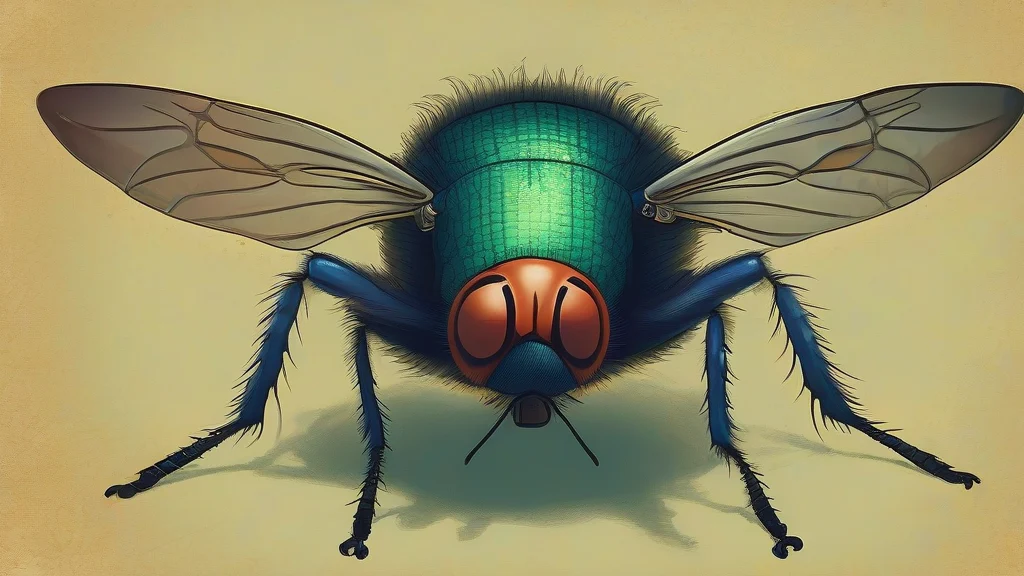
What does blowfly mean?
A blowfly is any member of the dipteran family Calliphoridae — robust flies, often with striking metallic blue or green bodies, that are drawn to decaying organic matter. The name comes from an archaic sense of 'blow', referring to the laying of eggs or the appearance of maggots in flesh. Female blowflies deposit their eggs on carrion, rotting food, open wounds, or sometimes the fleece of living sheep, and the larvae hatch rapidly into maggots. This habit makes blowflies both economically important and troublesome: they cause 'blowfly strike', a serious condition in livestock, while also serving a valuable ecological role as decomposers and pollinators. In forensic science, the predictable timing of blowfly colonization allows investigators to estimate the post-mortem interval of human remains. Common examples include the bluebottle and greenbottle flies familiar in gardens across Britain and North America.
nounA blowfly is a large, often metallic blue or green fly of the family Calliphoridae whose larvae (maggots) develop in decaying meat, carrion, and sometimes wounds or living tissue. Blowflies are significant in forensic science for estimating time of death and can be serious pests in livestock.
- Any of various flies of the family Calliphoridae, typically with a metallic blue or green body, whose maggots feed on carrion, decaying matter, or living tissue.
"The carcass was soon covered in blowflies, their iridescent bodies glinting in the sun."
"The sheep had to be treated quickly after blowfly strike set in during the warm, wet weather."
"Forensic entomologists examined the blowfly larvae to estimate how long the body had been there."
Regular plural formation; used when referring to multiple individuals or species collectively.
"Several blowflies were trapped against the glass, buzzing persistently."
Blowflies are often the first guests to arrive at a dead body — so reliably within minutes that forensic scientists use them to pinpoint time of death.
Reviewed by Deb Chak, Editor. AI-assisted content curated by RJS Tech Solutions LLP.
Etymology of blowfly
The word blowfly combines 'blow' with 'fly'. The element 'blow' here preserves an old English verb sense — related to Middle English 'blowen' — meaning to lay eggs or to produce maggots in meat or flesh, giving rise to expressions like 'flyblown'. The compound is recorded from around the late 16th to early 17th century. It shares its origin with other compounds built on this older sense of 'blow', such as 'flyblown' and 'blowball' (the seed head of a dandelion).
How blowfly is actually used
Chiefly used in entomological, veterinary, forensic, and agricultural contexts; 'blow' in this word derives from an older sense meaning to lay eggs or produce maggots in flesh.
Easily confused with blowfly
A housefly (Musca domestica) is a smaller, dull grey-brown fly that breeds in refuse and does not typically lay eggs on carrion or wounds, unlike the blowfly.
Flesh flies (family Sarcophagidae) resemble blowflies but are usually duller grey with checkerboard patterning on the abdomen and give birth to live larvae rather than laying eggs.