What does bluebottle mean?
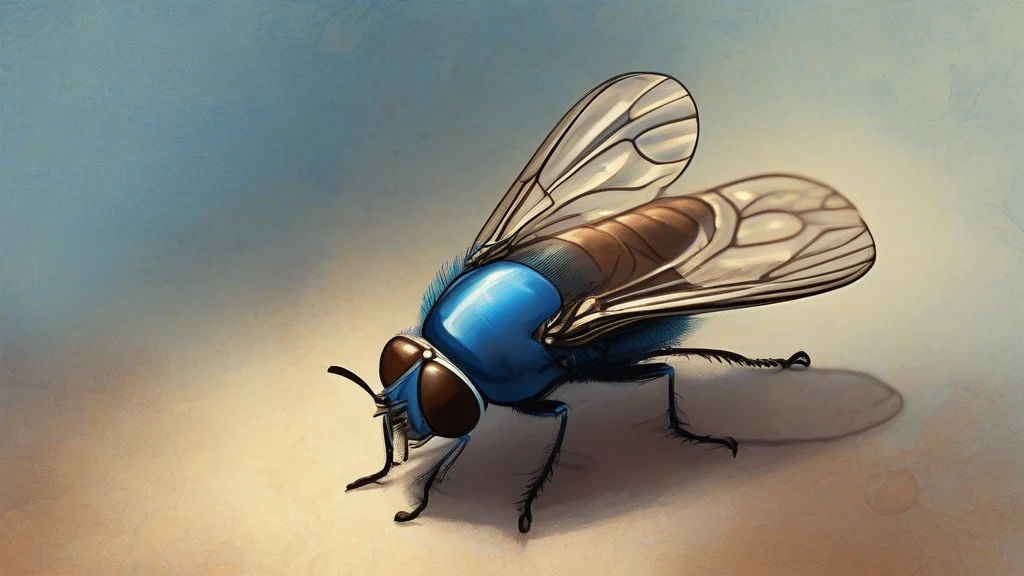
The bluebottle is best known as a large blowfly of the genus Calliphora, instantly recognisable by its metallic, electric-blue abdomen and its loud, buzzing flight. Common across Europe and North America, it breeds in decaying meat and carrion, which makes it an unwelcome visitor to kitchens, butchers' shops, and picnics, though it plays a genuine ecological role as a decomposer and even a pollinator. The word carries distinctly regional secondary meanings: in Australia, 'bluebottle' refers to the Indo-Pacific Portuguese man o' war, a floating colonial organism whose venomous tentacles deliver painful stings and regularly force the closure of popular beaches. In older British usage, it served as slang for a police constable, a sense preserved in Victorian fiction. This layering of meanings — pest, hazard, policeman — makes 'bluebottle' a vivid example of how a single compound of plain words ('blue' and 'bottle') can accumulate wildly different lives in different parts of the English-speaking world.
A large blowfly (genus Calliphora) with a metallic blue body, whose larvae feed on decaying flesh.
"She chased a bluebottle out through the open door."
This is the dominant sense in British and American English.
(Australian English) The Indo-Pacific Portuguese man o' war, a siphonophore with a blue float and long stinging tentacles.
"Swimmers were warned to watch for bluebottles along the shore."
Regional to Australia and nearby waters; this meaning predominates there.
(British English, archaic slang) A police officer or constable.
"The novel's streets swarm with bluebottes and pickpockets alike."
Chiefly historical; encountered in Victorian literature.
Standard pluralisation applies across all senses of the noun.
"Bluebottles gathered around the compost bin in the July sun."
The same word names an iridescent corpse-fly, a Victorian policeman, and one of Australia's most feared beach hazards — three creatures you'd never want to meet at a picnic.
Reviewed by Deb Chak, Editor. AI-assisted content curated by RJS Tech Solutions LLP.
Etymology of bluebottle
The word is a straightforward English compound of 'blue', describing the insect's striking metallic colouring, and 'bottle', an old term for a fly that lays its eggs in meat or bottles — the same element that gives us 'blowfly' and 'botfly'. It arose in English by at least the early seventeenth century, when naturalists began cataloguing flies by their appearance and habits. Its later figurative senses grew organically from the insect's associations: the blue-uniformed police officer borrowed the name in nineteenth-century British slang, while Australian settlers applied it to the stinging siphonophore washed ashore on their beaches.
How bluebottle is actually used
The insect sense dominates in Britain, where the word is strongly associated with summer kitchens and butchers' shops. In Australian English the word primarily means the jellyfish-like siphonophore, so context matters greatly by region. The 'police officer' sense is now largely historical, familiar mostly from Victorian literature such as Dickens.
Easily confused with bluebottle
A greenbottle is a similar blowfly with a metallic green rather than blue body.
A bluebell is a woodland flower with bell-shaped blue blooms, entirely unrelated to the insect despite the similar 'blue-' prefix.