What does bluethroat mean?
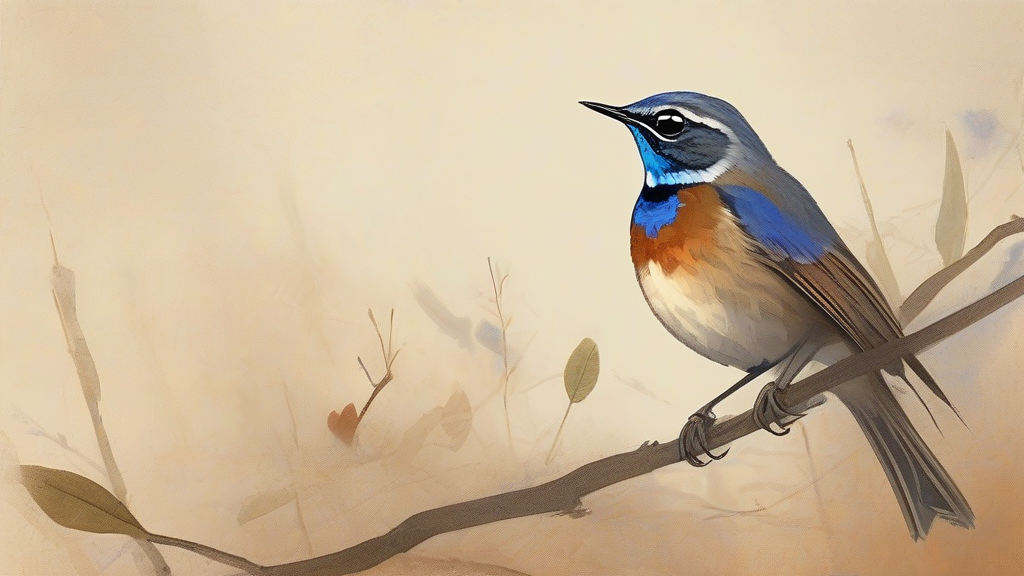
The bluethroat is a small passerine songbird of the Old World, scientifically known as Luscinia svecica and placed in the family Muscicapidae, the Old World flycatchers and chats. Breeding across northern Europe and Asia — from Scandinavia and the Alps to Siberia and Alaska's Seward Peninsula — it migrates to wintering grounds in North Africa, the Middle East, and southern Asia. The species is named for the adult male's most arresting feature: a brilliant iridescent blue throat and upper breast, typically marked by a central spot that is chestnut-red in northern populations and white in others. Females and juveniles are plain brownish birds without the blue. Bluethroats favor wet habitats such as reed beds, willow scrub, and tundra streamsides, where males deliver rich, skylark-like songs from low perches. In birdwatching circles the bluethroat is considered a sought-after prize, particularly in western Europe where it is localized and often elusive, and its arrival each spring is a highlight of the migration season for many observers.
nounA small migratory Eurasian songbird (Luscinia svecica, family Muscicapidae), the male of which has a striking blue throat patch, often with a central spot of red or white.
- A small Eurasian songbird, Luscinia svecica, whose breeding male has a vivid blue throat patch; it winters in north Africa and southern Asia and is a prized sighting among birdwatchers.
"The male bluethroat sang from the reed bed, flashing its brilliant cobalt bib at every pause."
"We waited near the marsh for an hour before the bluethroat finally emerged onto an exposed perch."
"In spring, the male bluethroat's rich, varied song carries far across the willow scrub of its breeding grounds."
Regular English plural; used when referring to multiple individuals or the species collectively.
"Several bluethroats were singing along the drainage channels at dawn."
Only the male bluethroat wears that dazzling sapphire bib — and its exact pattern of spots varies so much across its vast range that birders use it to tell populations apart.
Reviewed by Deb Chak, Editor. AI-assisted content curated by RJS Tech Solutions LLP.
Etymology of bluethroat
The word bluethroat is a straightforward English compound formed from 'blue' + 'throat', coined as the vernacular name for this bird because only the male shows the vividly colored throat patch. Such descriptive compound names are typical of English bird nomenclature, which pairs a color with a body part to distinguish similar small songbirds. It is not borrowed from another language, though many continental languages have equivalent descriptive names for the same species.
Related word forms
How bluethroat is actually used
Used almost exclusively in ornithological and birding contexts. The plural 'bluethroats' follows regular English noun inflection. Because it is a proper taxonomic common name, it is normally lowercased except in formal species lists.
Easily confused with bluethroat
The red-spotted bluethroat is not a separate confusion but a subspecies (Luscinia svecica svecica) whose male has a chestnut central spot on the blue throat, whereas other populations have a white or no spot.