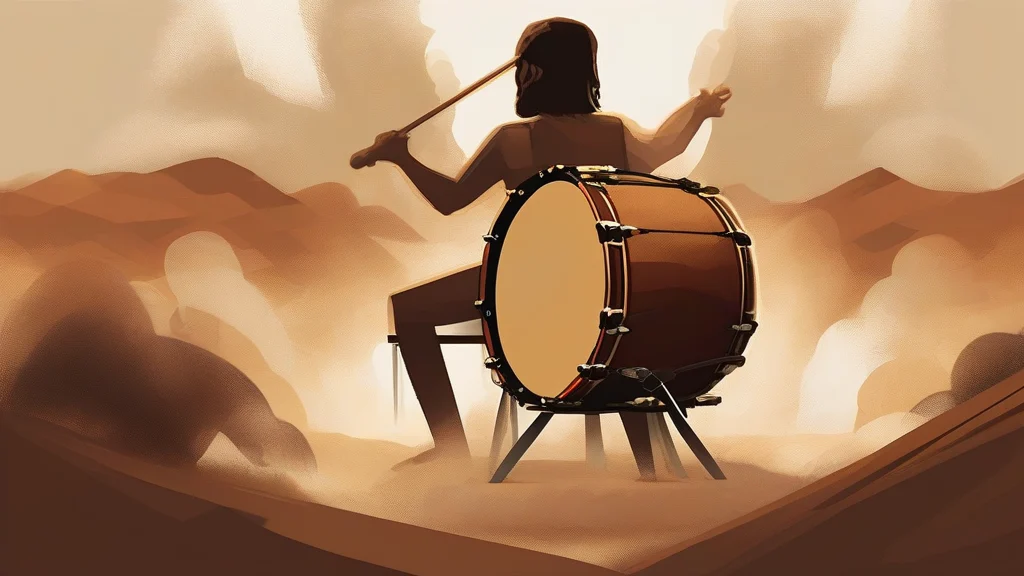
What does bombo mean?
Bombo is the word used in Spanish and Italian for a bass drum — the large, low-pitched drum that provides the foundational pulse in parades, festivals, and folk music across Spain, Italy, and much of Latin America. Played with a mallet or beater, the bombo produces the deep, resonant beats heard in everything from Andean folk ensembles to carnival processions, where it often anchors the rhythm for dancers and marching musicians. Although the word circulates among musicians and ethnomusicologists writing in English, it is not an established entry in mainstream English dictionaries, so English speakers most often encounter it as a loanword, in discussions of world music, or as a place name such as Bombo in New South Wales, Australia. For readers interested in percussion traditions, bombo is a useful term precisely because it names a specific instrument within those musical cultures rather than a generic drum, carrying connotations of communal celebration and folk heritage wherever it is played.
nounIn Spanish and Italian, bombo is a bass drum or a large drum. It is not an established entry in standard English dictionaries, appearing in English mainly as a loanword, a place name (notably Bombo, New South Wales, Australia), or a taxonomic name.
- A large bass drum used in Spanish-, Italian-, and Latin American–style music and festivals.
- (As a proper noun) A locality in New South Wales, Australia, near Kiama.
"The parade's bombo set the deep, steady pulse that the whole band marched to."
"She tightened the head of the bombo before the procession began."
"The folk troupe's rhythm section was built around a single bombo played with a mallet."
In English contexts, bombos follows regular English pluralization rather than adopting a Spanish plural form.
"Two bombos anchored the rhythm section of the festival band."
That deep boom-boom at the heart of a Latin American parade has its own name: the bombo.
Reviewed by Deb Chak, Editor. AI-assisted content curated by RJS Tech Solutions LLP.
Etymology of bombo
Bombo derives from Romance roots relating to drums and booming sound; the Spanish and Italian forms are closely parallel and both denote a large drum. The word belongs to a family of terms connected with hollow, resonant noise, cognate in spirit with English borrowings such as bombast and bombard, which trace back through medieval Latin and Greek words for padded or booming things. Its use as a place name in Australia is unrelated etymologically, reflecting instead local naming history.
How bombo is actually used
In English-language contexts, bombo is best treated as a loanword describing traditional drums of Spain, Italy, and Latin America; it is not part of general English vocabulary. Writers should italicize it on first use for clarity.
Easily confused with bombo
A combo is a small musical group or combination, whereas a bombo is a large bass drum.
Gumbo is a Louisiana stew thickened with okra, unrelated to bombo despite the similar ending.