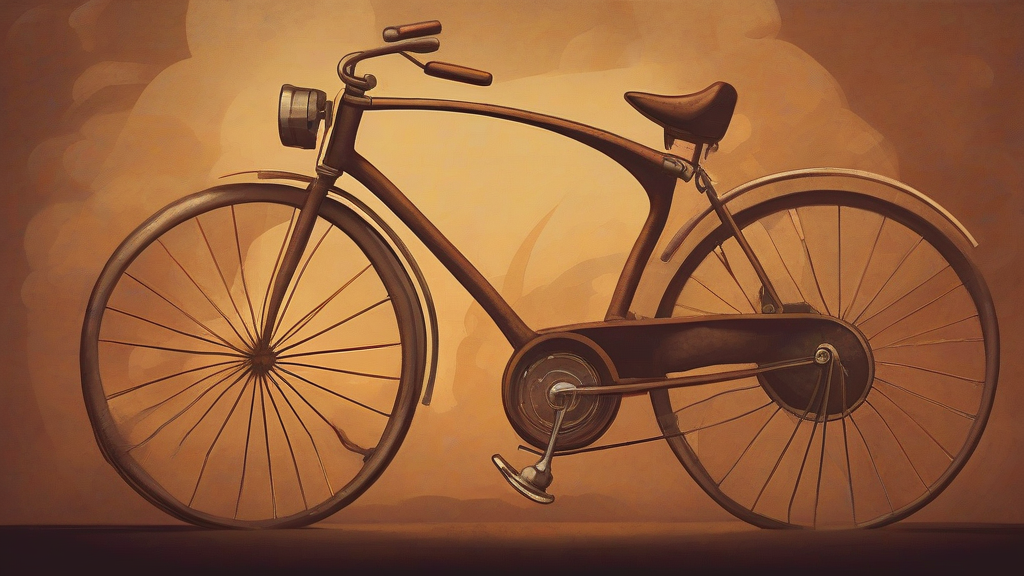
What does boneshaker mean?
A boneshaker is an early form of bicycle, popular in the 1860s, characterised by a heavy frame and tyres made of solid wood or iron-clad rubber. Because these machines had no suspension and no pneumatic tyres, they transmitted every bump in the road directly to the rider, earning them a name that vividly describes the experience. The term later broadened into informal use, especially in British English, to describe any dilapidated vehicle — car, van, or bike — that delivers an uncomfortably bumpy ride. The boneshaker holds an important place in cycling history: it was one of the first pedal-driven bicycles available to the public, preceding the penny-farthing and eventually the modern safety bicycle. Today the word appears mostly in historical writing about cycling's origins and in affectionate, humorous descriptions of well-worn vehicles. Its enduring charm lies in how honestly it conveys discomfort: few words capture mechanical misery quite so memorably.
nounAn early type of bicycle with a rigid iron frame and solid rubber tyres, so called because it jolted its rider painfully over uneven roads. More generally, any rickety, uncomfortable vehicle that gives a rough ride.
- A mid-19th-century bicycle with an iron or wooden frame and solid tyres, notorious for its jolting ride.
- Informally, any old, uncomfortable vehicle giving a bumpy ride.
"The museum's prize exhibit is an 1869 boneshaker with wooden wheels and a handbrake."
"Cycling pioneers braved cobbled streets on their boneshakers long before air-filled tyres brought comfort."
"Grandad still drives that ancient boneshaker of a van to the allotment every Sunday."
Regular plural; used both for multiple historical bicycles and colloquially for several such vehicles.
"The rally featured a dozen gleaming boneshakers from the 1870s."
Before pneumatic tyres existed, cyclists rode contraptions so brutal they were literally named for the way they rattled your bones.
Reviewed by Deb Chak, Editor. AI-assisted content curated by RJS Tech Solutions LLP.
Etymology of boneshaker
The word is a transparent English compound of 'bone' and 'shaker', coined in the mid-nineteenth century to mock the violent vibration produced by early bicycles on rough roads. It arose during the first cycling boom of the 1860s in Britain, when French-style velocipedes with rigid frames reached English riders. The same compound logic later extended figuratively to any jolting vehicle. It shares its components with ordinary English 'shake' (from Old English 'sceacan') rather than any classical root.
How boneshaker is actually used
The word is chiefly historical when referring to the early bicycle (roughly the 1860s), but it survives in informal British and Australian English as a affectionately derisive term for any battered vehicle. It carries a mildly comic, nostalgic tone rather than harsh criticism.
Easily confused with boneshaker
A penny-farthing is the high-wheeler bicycle with a huge front wheel that succeeded the boneshaker, whereas a boneshaker had two smallish wheels and a rigid frame.