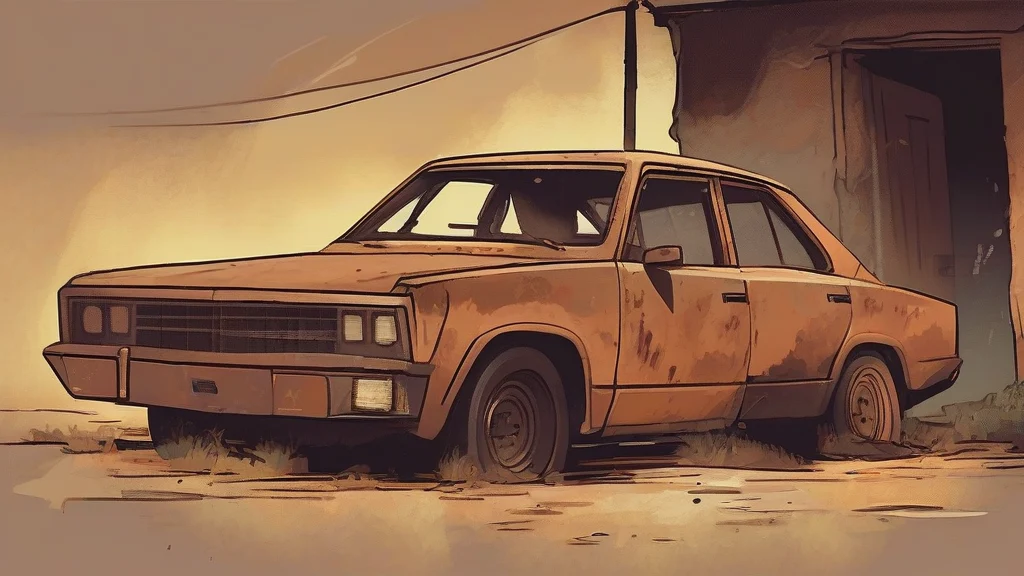
What does clunker mean?
A clunker is an old, dilapidated, or poorly made machine—most often a car—that runs badly or has nearly stopped running altogether. The word carries a distinctly informal, slightly affectionate connotation: while a clunker is by definition unreliable and unattractive, calling someone's vehicle a clunker is rarely cruel and often evokes fondness for a battered but beloved possession. The term originated in American English in the mid-twentieth century, built on the verb 'clunk', which describes the heavy, graceless sound such machines make. Beyond vehicles, clunker extends to any product or performance that disappoints—a flop film, a faulty appliance, a losing investment. It entered political discourse through 'cash for clunkers', the 2009 US trade-in program that paid owners to retire inefficient old cars. Synonyms include jalopy, lemon, wreck, and heap, though each carries its own shade of meaning; 'lemon' implies hidden defects, while 'clunker' emphasizes age and decrepitude.
An old, worn-out machine or vehicle, especially a car, that functions poorly or barely at all.
"She finally traded in her clunker for a reliable used hatchback."
Informal; most frequently applied to automobiles.
Anything, such as a product, performance, or idea, that turns out to be of very poor quality or a failure.
"The studio hoped the sequel would revive the franchise after the original's clunker of a first installment."
Standard regular plural; countable noun.
"The dealership's back lot was full of clunkers waiting to be stripped for parts."
'Cash for Clunkers' — the 2009 US government program — literally paid people to scrap their worst cars, cementing this word in the national vocabulary.
Reviewed by Deb Chak, Editor. AI-assisted content curated by RJS Tech Solutions LLP.
Etymology of clunker
Clunker derives from the verb 'clunk', an imitative or echoic word dating to around the early twentieth century, describing a heavy, dull metallic sound. The agentive suffix '-er' turned the sound into a label for things that make—or embody—such sounds: big, clumsy, aging machinery. The noun emerged in American English around the 1930s–1940s and quickly became the standard informal term for a beat-up automobile. Its relatives include 'clonk' and 'clank', all members of the same family of English words that mimic percussive noise.
Related word forms
How clunker is actually used
Informal register throughout; common in everyday speech and journalism but rare in formal writing. Strongly associated with cars in American English, where it overlaps heavily with 'jalopy'. The extended sense applies to any disappointing product or performance.
Easily confused with clunker
Clonk is a dull thudding sound (or the act of hitting something), whereas a clunker is a thing—an old, unreliable object or vehicle.