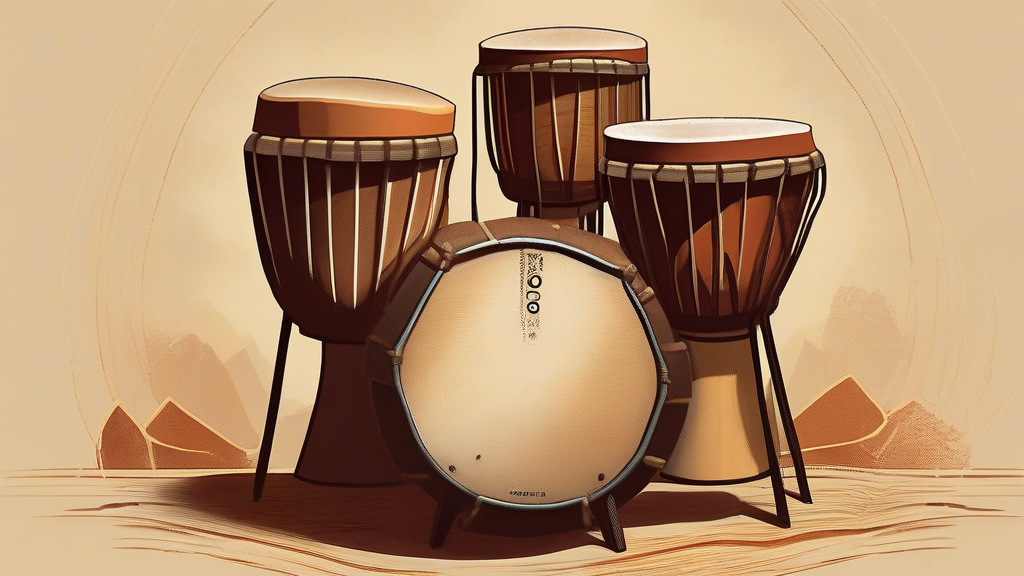
What does bongo mean?
The word bongo refers to two unrelated things that happen to share a name: a large African forest antelope and a pair of small hand drums. The antelope, Tragelaphus eurycerus, is the largest of Africa's forest antelopes, strikingly marked with vertical white stripes on a chestnut coat and crowned with spiralled horns; shy and nocturnal, it inhabits dense rainforests in central and eastern Africa. The musical bongo is a pair of small, open-bottomed drums joined together, held between the knees and played with the fingers and thumbs. Bongos originated among Afro-Cuban musicians and became internationally famous through Latin American music, particularly Cuban son and later jazz and rock. In casual conversation, the drum sense dominates — people usually say 'the bongos' — while the animal sense appears mainly in nature writing and conservation discussion. The word's double life makes it a memorable example of how one term can carry two entirely distinct meanings across different domains.
nounA bongo is either a large striped forest antelope of central Africa (Tragelaphus eurycerus), or one of a pair of small attached hand drums of Afro-Cuban origin played with the fingers.
- Either of a pair of small attached single-headed hand drums of Afro-Cuban origin, played with the fingers and thumbs.
- A large spiral-horned forest antelope (Tragelaphus eurycerus) native to central and eastern Africa, with a chestnut coat marked by vertical white stripes.
"The bongo slipped silently through the dense undergrowth, its white stripes breaking up its outline."
"He kept a steady rhythm on the bongos while the guitarist improvised over the top."
"Conservationists estimate that fewer bongos remain in the wild than in captivity."
For the drums, the standard English plural is 'bongos', though the pair as a whole is often referred to simply as 'the bongos'. For the antelope, 'bongos' is now the usual plural, though 'bongo' has historically been used unchanged.
"Two bongos emerged briefly at the edge of the clearing before vanishing into the forest."
The bongo is Africa's largest forest antelope — yet it's so elusive that scientists learned more about it from camera traps than from direct observation.
Reviewed by Deb Chak, Editor. AI-assisted content curated by RJS Tech Solutions LLP.
Etymology of bongo
Both senses of 'bongo' entered English from African sources, though their precise origins are not firmly established. The antelope name was adopted in the 19th century from a Central African language, possibly Kele, during European exploration of the Congo basin. The drum name likewise derives from African languages via Cuba, where enslaved Africans developed the instrument; it spread into English through Latin American music in the 20th century. No secure deeper root links the two words beyond their shared African geographic origins.
How bongo is actually used
In everyday speech 'bongo' most often refers to the drums, usually heard in the plural ('the bongos'); the antelope sense is more common in wildlife and conservation contexts. The word is informal to neutral in register.
Easily confused with bongo
A bonobo is a great ape closely related to the chimpanzee, whereas the bongo is an African forest antelope.
The conga is a single taller drum played standing, while bongos are a pair of small connected drums played seated and held between the knees.