What does borage mean?
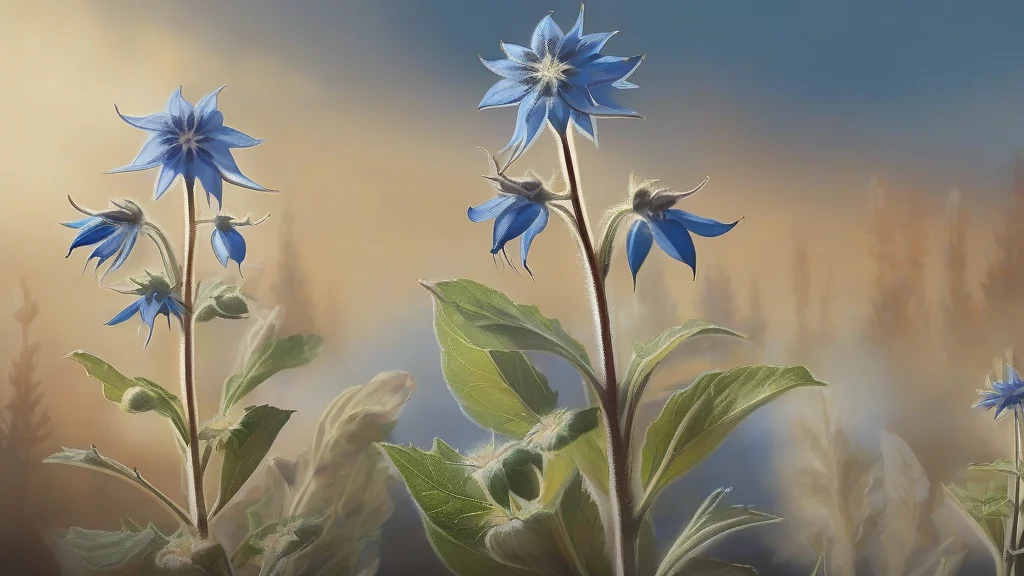
Borage is a hardy European herb (Borago officinalis), also called starflower, prized for its vivid blue, star-shaped flowers and rough, hairy foliage. Long cultivated in kitchen gardens, its young leaves can be eaten cooked or raw, while its delicate blossoms are famously used to garnish Pimm's and other summer drinks in Britain. The plant is equally valued by gardeners as one of the most bee-friendly species available — honeybees visit it constantly throughout the day. Historically, borage carried a reputation for lifting spirits and instilling courage, appearing in old herbal texts as a cure for melancholy, which is why it was sometimes embroidered on medieval garments as a symbol of bravery. Today it is grown ornamentally and practically, and its seeds yield borage oil, a commercial source of gamma-linolenic acid used in dietary supplements and skincare. Though rarely part of everyday conversation, borage remains a familiar word among cooks, gardeners, herbalists, and anyone with an interest in traditional English flora.
nounA European herbaceous plant (Borago officinalis) of the borage family, with rough hairy leaves and bright blue star-shaped flowers, used medicinally, in salads, and as a flavouring. Also known as starflower or bugloss.
- The herbaceous plant Borago officinalis, with hairy leaves and blue star-shaped flowers.
- The edible blue flowers or young leaves of this plant, used in salads, drinks (notably Pimm's), and as a garnish.
- (Less common) Borage seed oil, extracted from its seeds and rich in gamma-linolenic acid.
"She scattered fresh borage flowers over the Pimm's as a traditional garnish."
"The bees were drawn irresistibly to the borage at the edge of the vegetable garden."
"Add a few borage blossoms to each glass for that classic English summertime touch."
Rarely pluralised — usually treated as an uncountable mass noun when referring to the plant generally; the plural appears only when distinguishing multiple varieties or specimens.
"Several borages are cultivated across Europe for their ornamental value."
Borage flowers were once floated in Pimm's cups and embroidered onto medieval knights' clothing for courage — the plant was literally believed to drive away melancholy.
Reviewed by Deb Chak, Editor. AI-assisted content curated by RJS Tech Solutions LLP.
Etymology of borage
The word 'borage' entered Middle English from Old French 'bourrache', which itself derives from Medieval Latin 'borrago' or 'borra'. The ultimate root is likely Arabic 'abū ḥuraysh' ('father of shaggy hair'), referring to the plant's bristly foliage, though some scholars instead connect it via Latin 'borra' meaning coarse wool or shaggy cloth — either way, the reference is to the plant's hairy texture. It has been in English use since at least the medieval period, long predating modern botanical naming.
How borage is actually used
Mostly encountered in gardening, herbal medicine, cookery, and botanical writing rather than everyday speech. In British contexts it carries strong associations with summer drinks like Pimm's; elsewhere it is more likely to be discussed as a bee-friendly garden plant or a source of nutritional oil.
Easily confused with borage
'Burgundy' refers to a wine-producing region and its wine; 'borage' is an herb — the words merely sound vaguely similar.