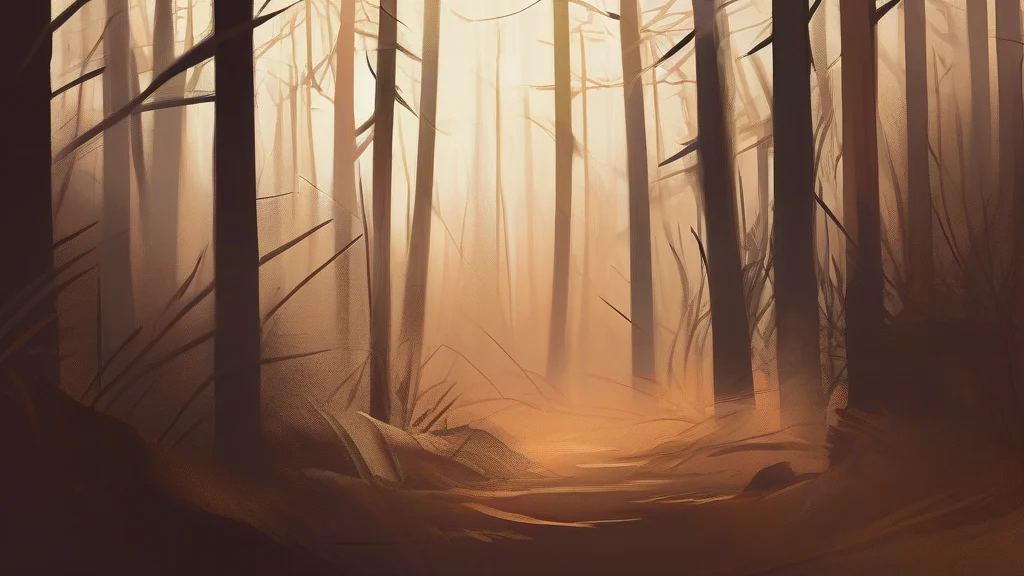
What does boskage mean?
Boskage refers to a mass or growth of trees and shrubs, especially when dense, leafy, and casting deep shade. It is essentially a more poetic synonym for terms like thicket, copse, or woodland, though it tends to suggest pleasant, sheltering greenery rather than tangled wilderness. The word derives from Middle English bosk, meaning a bush or shrub, which shares ancestry with modern bush. In practice, boskage belongs chiefly to literary and descriptive writing: it appears in poetry, nature prose, and discussions of landscape painting, where writers use it to evoke cool glades, shaded walks, and the soft outlines of tree cover on a horizon. Because it is rare in ordinary conversation, using it lends prose a deliberately elevated, pastoral flavor. A writer might describe a lane disappearing into boskage or a painter framing a scene with its dark foliage. For readers who enjoy precise vocabulary for the natural world, boskage offers a compact and evocative alternative to plainer words for clustered trees.
nounA mass or expanse of trees and shrubs; woodland growth, especially when dense and shady.
- A dense mass or growth of trees and shrubs; thick, shady woodland.
"The path wound through cool boskage before opening onto the sunlit meadow."
"They pitched their tent at the edge of the boskage, sheltered from the wind by oaks and hazels."
"In his landscape paintings, Constable often framed his skies with dark masses of boskage."
The plural is rare, since boskage usually denotes woodland growth as an uncountable mass; it appears mainly in literary contexts referring to multiple distinct stretches of trees.
"The estate was dotted with small boskages, each one a cool retreat from the summer sun."
Boskage comes from the same ancient root that gave us 'bush' — making it a poetic way to say 'a whole lot of bushes.'
Reviewed by Deb Chak, Editor. AI-assisted content curated by RJS Tech Solutions LLP.
Etymology of boskage
Boskage comes from Middle English bosk, meaning a bush or shrub, combined with the noun-forming suffix -age. The root bosk is related to the Germanic source of modern English bush and has parallels in Dutch and other continental Germanic languages. The word was in use by the sixteenth century, appearing in poetry and descriptive prose as a term for wooded growth.
How boskage is actually used
Boskage is literary and somewhat archaic in register; it appears mostly in poetry, landscape description, and older prose rather than everyday speech. It carries a connotation of pleasant, sheltering greenery rather than wild or impenetrable forest.
Easily confused with boskage
Boscage is an older variant spelling of the same word, both meaning a mass of trees or bushes; they are essentially interchangeable in sense.
Though visually similar in ending, a bouquet is an arrangement of cut flowers, whereas boskage refers to living trees and shrubs growing together.