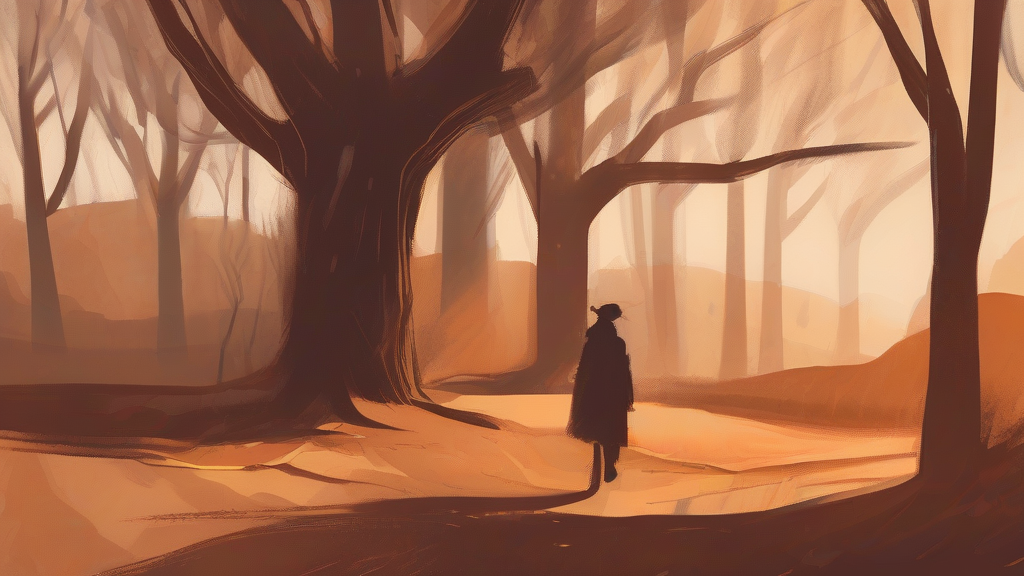
What does boughless mean?
Boughless is a rare English adjective used to describe a tree or woody plant that has no boughs — that is, no large branches. It most often appears in literary and descriptive writing, evoking images of storm-damaged oaks, lightning-scorched pines, or trees deliberately pollarded until only their trunks remain. Because a tree stripped of its boughs looks skeletal and exposed, the word carries strong connotations of bleakness, desolation, and loss, making it a favorite of poets and nature writers seeking a vivid, compact image. It is formed simply by attaching the suffix '-less' to 'bough', the long-established English noun for a main branch of a tree, a noun that reaches back to Old English. Though you are unlikely to encounter 'boughless' in everyday conversation, it is a precise and evocative term: where 'bare' might describe a tree merely without leaves, 'boughless' specifies the absence of the branches themselves. For writers describing winter landscapes, ruined orchards, or the aftermath of storms, it offers a single word that captures a whole scene of arboreal devastation.
adjectiveHaving no boughs or large branches; said especially of a tree that has been stripped of its limbs or stands bare of them.
- (of a tree or woody plant) lacking boughs or large branches
"The storm left a single boughless oak standing sentinel over the field."
"The lightning-scorched pine stood boughless against the winter sky."
"Pollarded for decades, the old limes were boughless save for a crown of new shoots."
Boughless is the word for a tree reduced to its skeleton — and it hides an ancient root shared with the archer's bow and your elbow.
Reviewed by Deb Chak, Editor. AI-assisted content curated by RJS Tech Solutions LLP.
Etymology of boughless
Boughless is formed from the Middle English noun 'bough', meaning a main branch of a tree, which descends from Old English 'bōg' or 'bōh', originally denoting the shoulder or arm and by extension the arm-like limb of a tree. This Old English word belongs to the Germanic family of terms derived from the Proto-Germanic verb meaning 'to bend' — the same root that gives us 'bow' (both the bent weapon and the act of bending) and survives in 'elbow', literally the 'arm-bend'. The suffix '-less' is likewise native English, from Old English '-lēas', meaning 'free from' or 'devoid of'. Boughless is thus built entirely of native Germanic material, and its rarity today reflects its specialized, largely poetic niche rather than any great antiquity.
How boughless is actually used
Boughless is a rare, chiefly literary adjective. It appears mostly in descriptive or poetic prose about damaged, dead, or deliberately pruned trees, and it carries a connotation of bleakness or desolation.
Easily confused with boughless
Boundless means limitless or infinite, while boughless describes something—usually a tree—that lacks branches.