What does bouldered mean?
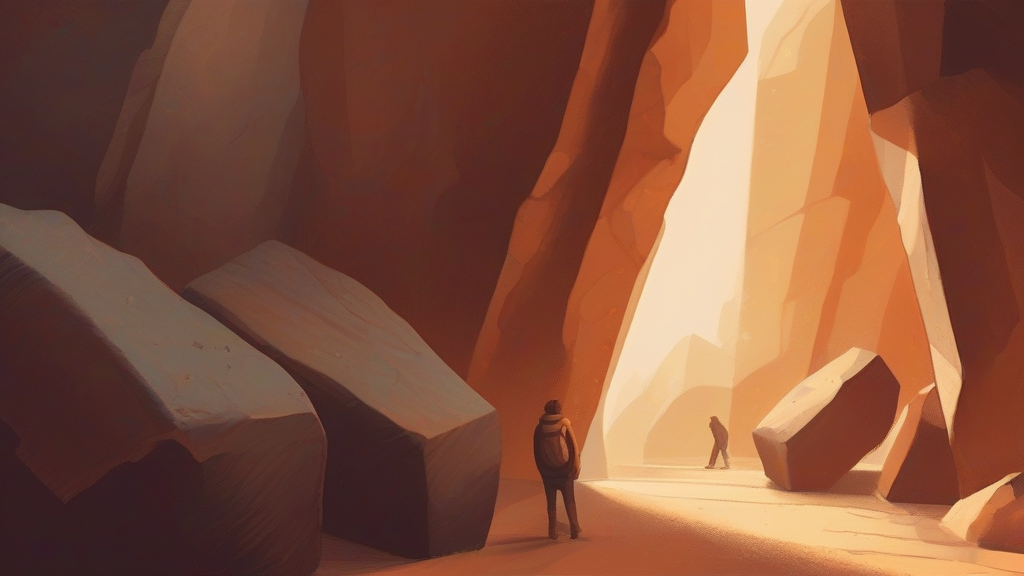
'Bouldered' is an adjective describing land that is covered with or scattered thickly with boulders — large, rounded masses of rock typically bigger than a fist and often much larger. It applies most naturally to natural features such as hillsides, mountain trails, beaches, moraines, and dry riverbeds, as in 'a bouldered slope above the valley.' The word carries no emotional connotation of its own; it is descriptive and precise, which makes it valuable in geology, geography, and outdoor writing where 'rocky' would be too vague, since rocky ground might hold anything from gravel to cliffs. Though it sounds like the past tense of a verb, it is in fact formed by adding the adjectival suffix '-ed' to the noun 'boulder,' much as 'wooded' derives from 'wood.' The noun itself came into Middle English from Scandinavian sources, giving 'bouldered' a distinctly northern European pedigree.
adjectiveCovered or strewn with boulders; having many large rounded rocks on its surface.
- Covered with or full of boulders, said especially of ground, slopes, beaches, or riverbeds.
"The trail climbed steadily across the bouldered slopes above the tree line."
"The path wound through bouldered terrain that made every step a careful choice."
"Glaciers retreated millennia ago, leaving behind a bouldered plain dotted with scrubby pines."
Despite sounding like a past-tense verb, 'bouldered' is an adjective — and it's the only everyday English word that turns a single giant rock into a whole landscape.
Reviewed by Deb Chak, Editor. AI-assisted content curated by RJS Tech Solutions LLP.
Etymology of bouldered
The word 'bouldered' is formed from 'boulder' plus the adjectival suffix '-ed,' which turns nouns into descriptors of being covered with something, as in 'wooded' or 'tree-lined.' The noun 'boulder' entered Middle English during the medieval period from Scandinavian sources, related to Swedish dialect words for large round stones such as 'bullersten,' literally 'noisy stone,' a reference to boulders rumbling in streams. Because the base word is of Scandinavian rather than Latin origin, 'bouldered' has few true cognates among Latinate English vocabulary.
How bouldered is actually used
'Bouldered' is a relatively rare descriptive adjective, used chiefly in geography, geology, hiking, and landscape writing. It is neutral in register but appears mostly in written rather than conversational English, where speakers tend to say 'rocky' or 'full of boulders.' It is formed with the common adjectival suffix '-ed' added to the noun 'boulder,' not as a verb form.
Easily confused with bouldered
'Bolder' means more courageous or more prominent (the comparative of 'bold'), while 'bouldered' means covered with large rocks.