
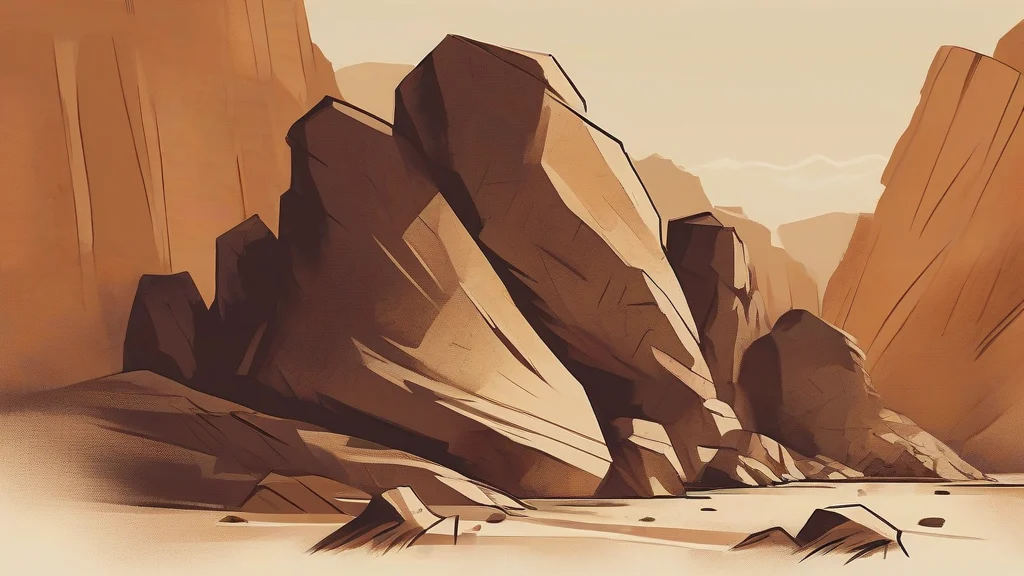
What does craggy mean?
Craggy is an adjective describing land dominated by steep, rugged rock formations — craggy cliffs, coastlines, hillsides, and peaks. By extension, it is also widely used of human faces: a craggy face has strong, angular, weathered features, often with deep lines, and the term typically conveys character and rugged appeal rather than mere plainness, being applied chiefly to men. Both senses are standard in British and American English, and neither is formal or informal in register. The word derives from crag, itself borrowed from Celtic languages meaning a steep, rocky mass, so craggy carries an inherently northern and upland flavor — evoking Scotland's Highlands, the English Peak District, or windswept coastal headlands. It is useful precisely because it suggests more than bare rockiness: craggy terrain feels dramatic, weathered, and imposing, which is why writers reach for it when they want landscape or physiognomy with texture and personality.
Having many steep, rugged rocks or cliffs; rough and rocky.
"The island's craggy shoreline made landing difficult."
(Of a face) having strong, angular, weathered features.
"The actor's craggy good looks suited him to western roles."
Craggy comes from a Celtic word for a steep rock — and it's one of the rare English words we happily use for both mountain faces and human ones.
Reviewed by Deb Chak, Editor. AI-assisted content curated by RJS Tech Solutions LLP.
Etymology of craggy
Craggy derives from crag, a noun for a steep, rugged rock or cliff, which English borrowed from a Celtic source — related to Welsh craig and Scottish Gaelic creag, both meaning rock. The adjective formed with the common -y suffix appeared in English by around the early 17th century, first describing rugged terrain and later extended figuratively to angular, weathered faces. Its Celtic roots make it part of a small group of topographical words English absorbed from the languages of Britain rather than from Latin or French.
Related word forms
How craggy is actually used
Neutral to positive in tone. The figurative sense applied to faces is well established and usually implies character and rugged attractiveness rather than plain ugliness; it is most often said of men.
Easily confused with craggy
A crag is the steep rugged rock or cliff itself (a noun), while craggy is the adjective describing terrain — or a face — that resembles such rock.