What does bouldery mean?
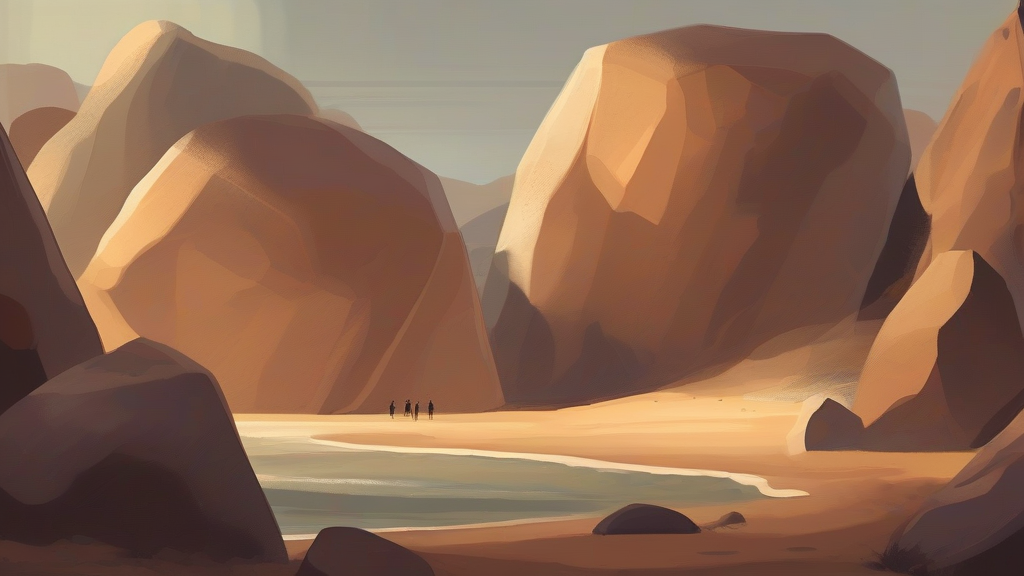
Bouldery is an adjective used to describe ground, terrain, or surfaces that are covered with, composed of, or strewn with boulders — large, rounded masses of rock. It appears most often in contexts of outdoor movement and natural description: a bouldery trail, a bouldery riverbed, or a bouldery moraine left behind by a retreating glacier. While closely related to the more common adjective "rocky," bouldery carries a more specific image, suggesting scattered or piled-up stones big enough to obstruct footing rather than merely gravel or loose scree. The word derives simply from "boulder" plus the suffix "-y," which forms adjectives meaning "characterized by" or "full of." Connotations are neutral to mildly negative when applied to paths and slopes, since bouldery ground implies slow, careful progress; in geological or scenic writing, however, it can be purely descriptive and even evocative. It remains a useful, vivid choice for writers who want precision beyond "rocky."
adjectiveCovered with, consisting of, or characterized by boulders; resembling or full of large rounded rocks.
- Full of or covered with boulders; strewn with large rounded rocks.
- Resembling a boulder in size, shape, or character.
"The trail grew increasingly bouldery as we climbed toward the glacier's edge."
"The river ran fast and shallow over its bouldery bed."
"They picked their way down the bouldery hillside, testing each step."
The word "boulder" itself likely crossed into English from a Scandinavian source, so every time you describe a bouldery hillside, you're using a bit of Viking-age vocabulary.
Reviewed by Deb Chak, Editor. AI-assisted content curated by RJS Tech Solutions LLP.
Etymology of bouldery
Bouldery is formed straightforwardly from the noun "boulder" combined with the adjectival suffix "-y," a productive English pattern seen in words like "mossy" and "hilly." The underlying noun "boulder" entered English around the early 17th century, most likely from a Scandinavian source such as a Swedish dialectal form for a rounded stone. Its earliest established use was actually geological: a "boulder" originally meant a detached water-worn mass of rock, giving rise to the scientific term "boulder clay" for glacial deposits. The adjective bouldery developed later as writers needed a compact way to describe terrain littered with such stones.
How bouldery is actually used
Chiefly descriptive and slightly informal in register; it appears most often in writing about hiking, geology, rivers, and glaciated landscapes, where it conveys rough, difficult walking ground more specifically than the broader term "rocky."
Easily confused with bouldery
"Boulder" is the noun naming a single large rock, while "bouldery" is the adjective describing ground or terrain covered with such rocks.
"Boldly" means courageously or confidently, whereas "bouldery" describes landscape strewn with large stones.