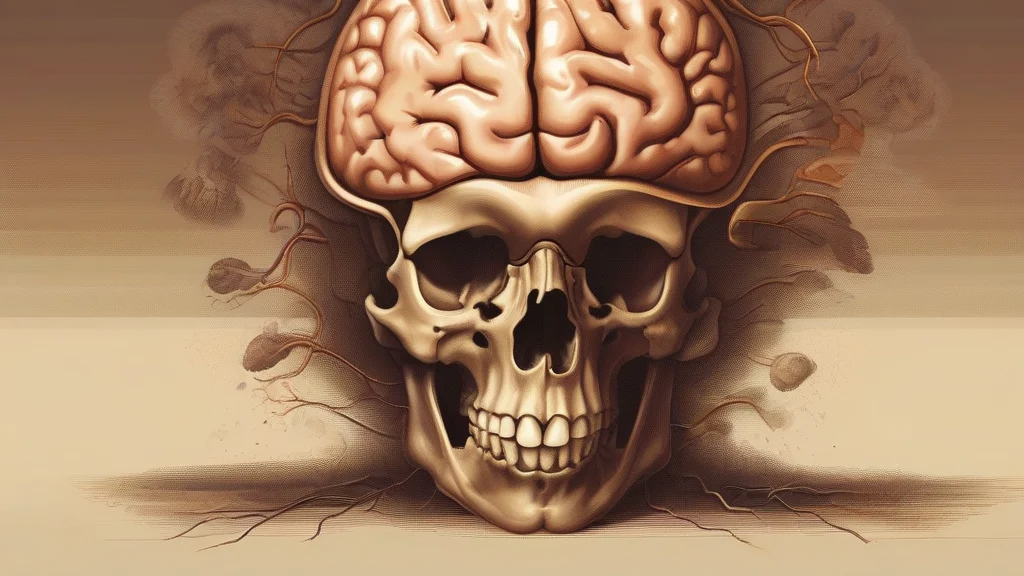
What does brain mean?
The brain is the organ of soft nervous tissue housed within the skull that serves as the body's command center, governing sensation, movement, memory, emotion, and thought. Beyond its biological meaning, the word is widely used figuratively to denote intelligence or mental sharpness: a person with 'a good brain' is clever, and 'racking one's brains' means thinking hard. Informally, a 'brain' can be an exceptionally smart individual — 'the best brains in science' — while 'the brains of an operation' identifies its mastermind. As a verb, chiefly in informal speech, to 'brain' someone means to hit them forcefully on the head. The word carries no strong connotations of its own; tone depends on context, from clinical neuroscience writing to casual banter. Its versatility makes it essential vocabulary for discussing both anatomy and intellect.
The organ of soft nervous tissue in the skull that coordinates sensation, movement, thought, memory, and bodily function; also figuratively, a person's intelligence or an exceptionally intelligent person.
"The injury affected the part of his brain responsible for speech."
Usually singular for the organ; plural 'brains' often means intelligence collectively.
To strike someone forcefully on the head (informal).
"He threatened to brain anyone who touched his tools."
Informal and somewhat dated; rare outside colloquial or literary use.
Plural commonly denotes collective intelligence ('she's got brains') rather than multiple organs.
"It took all the brains in the department to crack the code."
Your brain is about 2% of your body weight but uses roughly 20% of your energy — the original power-hungry processor.
Reviewed by Deb Chak, Editor. AI-assisted content curated by RJS Tech Solutions LLP.
Etymology of brain
'Brain' comes from Old English 'brægen', which has cognates in other Germanic languages such as Dutch 'brein'. The word's ultimate origin before the Germanic family remains uncertain, and it does not derive from Latin or Greek roots — the classical-derived terms for the organ are 'cerebral' (from Latin 'cerebrum') and 'cranial' (from Greek 'kranion'). It has been part of English since its earliest recorded stages, making it one of the language's oldest anatomical terms.
Related word forms
How brain is actually used
'Brain' is neutral in register across formal and informal contexts. In plural form ('brains') it commonly means intelligence collectively ('use your brains'), while in informal British and American usage 'to brain someone' as a verb means to strike them on the head. The phrase 'the brains of' can refer to the mastermind behind a plan or operation.
Easily confused with brain
'Brine' is heavily salted water used for pickling or preserving food, while 'brain' is the organ of thought — they differ by a single vowel sound.
'Brawn' means muscular strength or physical power, often contrasted with 'brain' as mental ability.