What does braying mean?
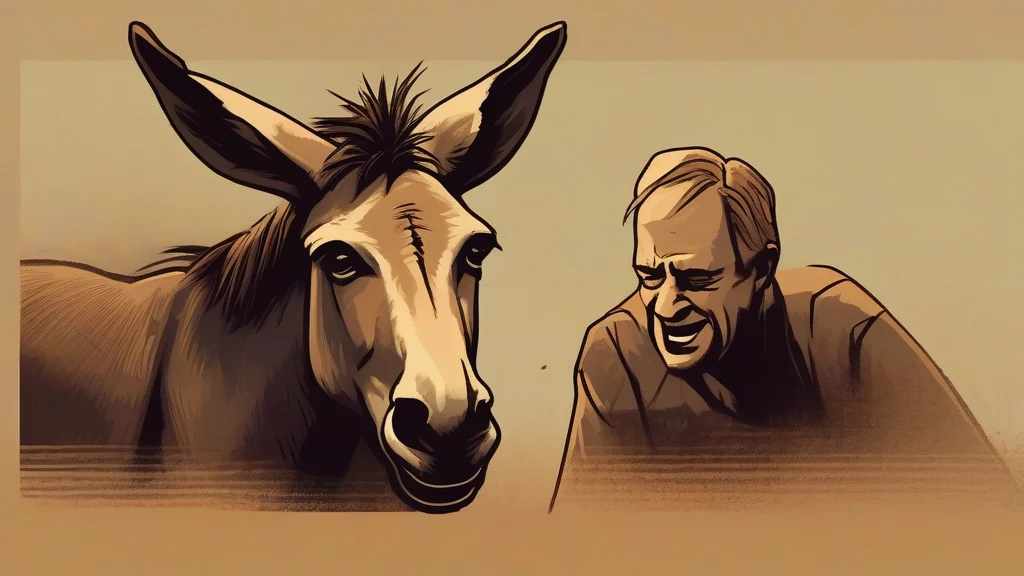
Braying describes the loud, harsh, broken cry made by a donkey or mule, and by extension any similarly grating sound produced by a person. As a verb form, it functions both literally — the donkey stood at the fence, braying at passers-by — and figuratively, where it characterizes human laughter or speech as coarse, loud, and unattractive, as in a braying voice dominating a dinner conversation. The figurative use carries a strongly negative connotation: it suggests vulgarity, arrogance, or an absence of grace, which is why it frequently appears in satirical writing and character description. The word traces back through Middle English and Old French, ultimately reflecting imitative origins for animal sounds. Because it vividly links an unmistakable animal sound to an unflattering portrait of human behavior, braying remains a compact and expressive choice for writers who want to convey both noise and contempt in a single word.
A loud, harsh, broken cry such as that made by a donkey; also, a similar coarse sound made by a person.
"We heard the braying of the mules echoing down the valley."
Used chiefly in literary or descriptive contexts; applied to people, it implies mockery.
Present participle of 'bray': to utter the loud, harsh cry of a donkey, or to laugh or speak loudly and coarsely.
"The donkeys were braying impatiently for their breakfast."
The human sense is always pejorative.
Rarely used; the noun is almost always treated as uncountable when referring to the general sound.
"The dawn was filled with the brayings of restless donkeys."
A donkey's bray can carry for over two miles across open terrain — nature's original long-range broadcast.
Reviewed by Deb Chak, Editor. AI-assisted content curated by RJS Tech Solutions LLP.
Etymology of braying
Braying derives from the verb 'bray', which entered Middle English from Old French 'braire'. The Old French verb is usually traced to a Vulgar Latin form such as '*bragere', whose ultimate source is generally thought to be Celtic, though the exact prehistory is debated. Like many animal-noise words, it likely originated partly in imitation of the donkey's call itself, and its figurative application to coarse human voices developed later.
Related word forms
How braying is actually used
When applied to humans, 'braying' is always derogatory and mocking, implying vulgarity, self-satisfaction, or lack of refinement — as in 'his braying voice'. It appears most often in literary and journalistic prose rather than everyday speech.
Easily confused with braying
Baying refers to the deep, prolonged howling of hounds (or a passionate public outcry), while braying refers to the harsh, broken cry of a donkey or to coarse human laughter.