What does brent mean?
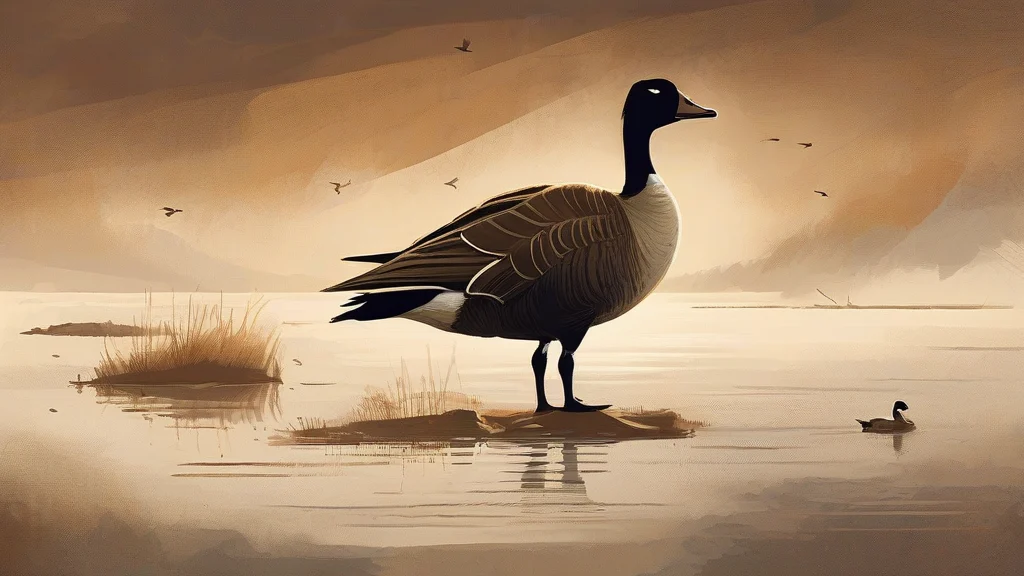
A brent is a small, dark sea-goose, Branta bernicla, that nests in the high Arctic tundra each summer and then migrates south to winter along temperate coastlines, where it grazes on seagrass, algae, and salt-marsh plants. In Britain it is known as the brent goose, while North American usage favours the name brant, and several distinct populations — such as the dark-bellied and pale-bellied brent — are recognised by their plumage and migration routes. The word appears chiefly in ornithological writing and among birdwatchers, and its plural is often left unchanged when speaking of birds collectively. An older, now literary sense of 'brent' exists as a variant of 'burnt', surviving mainly in early poetry and ballads. For anyone interested in coastal wildlife, 'brent' is the word to know for one of the most familiar and far-travelled winter visitors to northern estuaries.
A small dark wild goose, Branta bernicla, which breeds in the Arctic and winters on temperate northern coasts and estuaries; called brant in North America.
"A flock of pale-bellied brent dropped into the bay ahead of the cold front."
Usually found in the compound 'brent goose' in everyday British usage.
Archaic variant of 'burnt'; the past participle of burn.
"The chronicle tells how the village was all with fire brent."
Survives only in Early Modern English literature and dialect; do not use in modern prose.
When referring to the birds collectively or in the compound 'brent geese', the noun usually remains uninflected; 'brents' is acceptable for individual birds counted separately.
"Several hundred brent were feeding along the tideline at dawn."
The humble brent goose commutes between the high Arctic and your local estuary every year — one of the great little migrants hiding in plain sight on British mudflats.
Reviewed by Deb Chak, Editor. AI-assisted content curated by RJS Tech Solutions LLP.
Etymology of brent
The name 'brent goose' is recorded in English by around the 15th–16th centuries, but its ultimate origin is genuinely uncertain; it may derive from an Old Norse or other Germanic source, possibly connected to a word meaning 'burnt', a reference sometimes suggested for the bird's dark plumage. The parallel form 'brant' arose independently in North American English. The archaic participial use of 'brent' meaning 'burnt' descends from Middle English forms related to Old English 'brand' (fire, torch) and the verb 'burn'.
Related word forms
How brent is actually used
Mostly used in ornithological and birdwatching contexts; plural is typically unchanged ('brent geese') when referring to birds collectively, though 'brents' also occurs. The archaic participial sense survives only in older literature.
Easily confused with brent
'Brant' is the standard North American name for the same goose (Branta bernicla), while 'brent' is the usual British name.
'Bent' means curved, angled, or determined, whereas 'brent' is a kind of Arctic-breeding coastal goose.