What does brant mean?
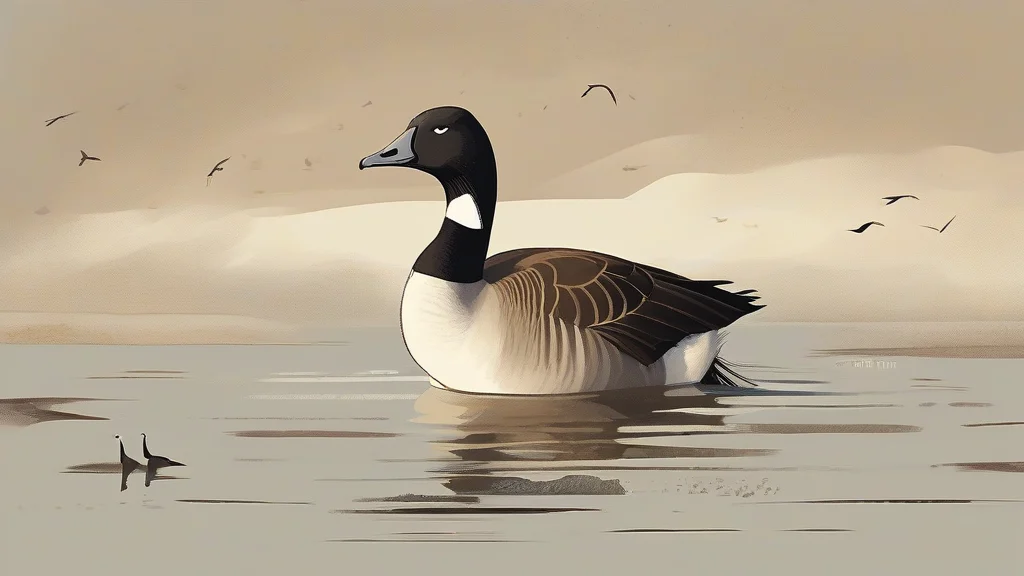
The brant is a small, compact wild goose of the genus Branta that breeds in the high Arctic tundra and winters along temperate northern coastlines of Europe and North America. Dark-bodied with a black head and neck, it is closely tied to the sea: unlike most geese, it feeds largely on eelgrass and other coastal vegetation, so its migrations follow the tides and the availability of salt-marsh plants. Several subspecies are recognized, including the darker black brant of the Pacific and the pale-bellied forms of the Atlantic. The word itself has an interesting history: it derives from a term meaning "burnt," a reference to the bird's sooty coloring, and the variant "brent" remains standard in British English. Because of its dependence on fragile coastal habitats, the brant is also a familiar touchstone in conversations about conservation and shoreline ecology.
nounA small Arctic-breeding wild goose (Branta bernicla) with a short bill and black head and neck, found along northern coastlines in winter; also called the brent goose.
- The small Arctic-breeding sea goose Branta bernicla (also called brent goose), which winters on northern coasts.
"Each October the mudflats fill with brant that have flown down from the high Arctic tundra."
"Thousands of brant pause at Delaware Bay each spring to refuel on eelgrass before continuing north."
"Hunters in the Pacific Northwest prize the black brant above nearly all other waterfowl."
The plural is most often left unchanged, particularly when referring to the birds as a group, but "brants" is also an accepted regular plural.
"The estuary shelters thousands of brant through the winter months."
The brant was once thought to be born from barnacles — medieval Europeans believed the geese hatched from shells on driftwood because no one ever saw them nest.
Reviewed by Deb Chak, Editor. AI-assisted content curated by RJS Tech Solutions LLP.
Etymology of brant
The word "brant" entered English in the sixteenth century as a name for this small coastal goose, borrowed from Scandinavian sources related to Old Norse "brandt," meaning burnt — an allusion to the bird's dark, scorched-looking plumage. The variant spelling "brent" arose early and became the dominant British form, surviving in the standard British name "brent goose." The root ultimately connects to Germanic words for burning, making the brant one of several bird names drawn from color metaphors.
How brant is actually used
The plural is typically "brant," unchanged, especially when referring to the birds collectively, though "brants" is also accepted. "Brent" is the more common form in British English, where the bird is usually called the brent goose; "brant" dominates in North American usage. The word is chiefly used by birders, hunters, and coastal naturalists rather than in everyday speech.
Easily confused with brant
"Brent" is simply an older variant name for the same goose (still standard as "brent goose" in British usage), whereas "brant" is the form now favored in North American English — they refer to the same bird, not different species.
"Grant" is a verb or noun relating to giving something formally, unrelated to the bird called a "brant."