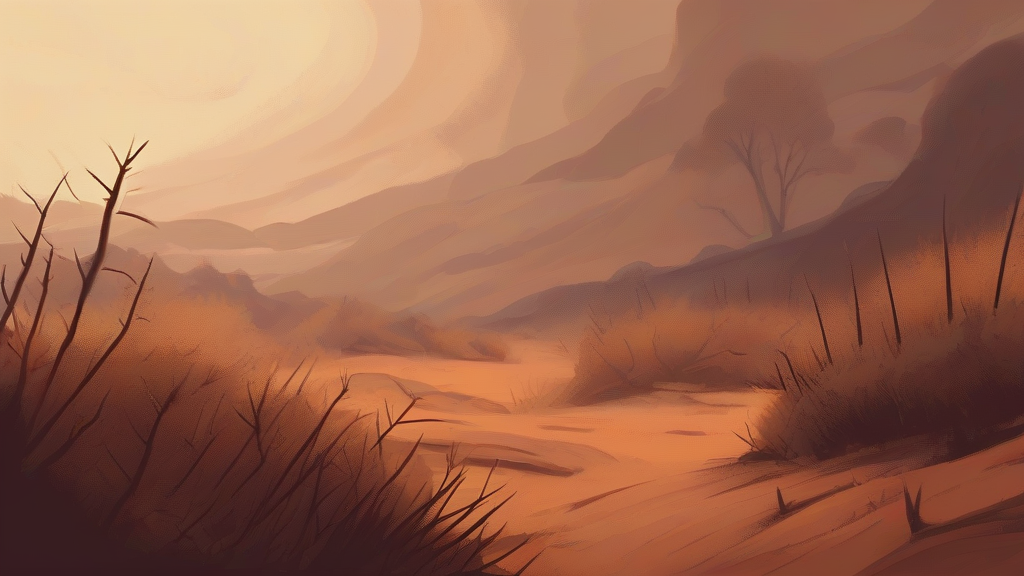
What does briery mean?
Briery is an adjective describing land or vegetation covered with briers — the prickly shrubs of the rose family, such as wild roses, blackberries, and related thorny plants. A briery hillside or briery thicket is one so dense with these spiny growths that passage is difficult and unpleasant, a sense familiar to anyone who has gone blackberrying and emerged scratched. The word derives from 'briar' (also spelled 'brier'), the noun for the plant itself, combined with the adjectival suffix '-y'. Though it can be used figuratively to suggest something rough, tangled, or thorny in character, this extended use is rare. Briery belongs chiefly to descriptive and literary English — it appears most naturally in nature writing, rural narrative, and landscape description, where its slightly old-fashioned flavor suits evocations of wild, untended countryside. It is understood throughout the English-speaking world but is not part of ordinary conversational vocabulary.
adjectiveCovered with or full of briers — prickly shrubs of the rose family such as blackberry and wild rose bushes.
- Overgrown or covered with briers or other prickly shrubs.
- (Figurative or descriptive) Characterized by roughness or prickly difficulty, as in describing terrain or prose style — a rarer extended use.
"The sheep refused to enter the briery hollow at the edge of the pasture."
"We lost the trail somewhere in the briery undergrowth below the ridge."
"Her early essays have a briery quality — dense, thorny, and rewarding to those patient enough to work through them."
Briery is the adjective hiding behind every blackberry-picking scratch — the reason the sweetest berries guard themselves best.
Reviewed by Deb Chak, Editor. AI-assisted content curated by RJS Tech Solutions LLP.
Etymology of briery
Briery is formed from the noun briar (also spelled brier) plus the suffix -y, making it a straightforward English derivation rather than a direct borrowing. The noun briar goes back to Middle English, ultimately from Old English brēr, a Germanic word denoting prickly shrubs. Cognate or related forms appear across the Germanic languages, reflecting a long history of describing thorny growth in northern European landscapes. The adjective arose as writers needed a term for terrain characterized by such plants.
Related word forms
How briery is actually used
Briery is a literary or descriptive word rather than everyday vocabulary; speakers are more likely to say 'thorny' or 'overgrown with briars' in casual speech. It carries a rustic, naturalistic connotation and appears most often in nature writing and rural description. The variant spelling 'briary' is equally acceptable.
Easily confused with briery
A briar is the prickly plant itself (a noun), while briery is the adjective describing a place overgrown with such plants.
Brambly describes places thick with brambles specifically, whereas briery refers more generally to any prickly shrubs, including wild roses.