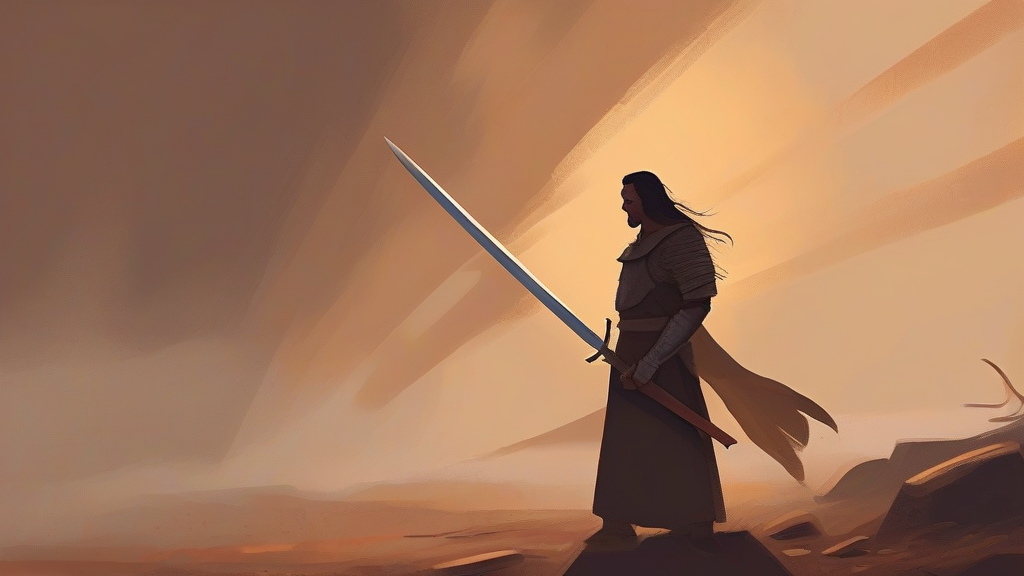
What does broadsword mean?
A broadsword is a type of sword characterized by a wide, heavy blade intended primarily for cutting blows rather than precise thrusting. The word arose in English in the early modern period to distinguish such weapons from narrower swords like the rapier, which had become fashionable for dueling and civilian wear. The most famous example is the Scottish basket-hilted broadsword, a single-handed weapon whose distinctive guard of metal bars shielded the wielder's entire hand; this form remained in use among Highland regiments into the nineteenth century. Today the word appears mostly in historical, martial-arts, and museum contexts, evoking images of Highland warriors and cavalry charges. It is occasionally confused with similar terms: a rapier is a slim thrusting blade, while the claymore was a much larger two-handed sword. For readers interested in arms and armor, 'broadsword' is the standard general term for the sturdy, edge-focused sidearm of medieval and Renaissance Europe.
nounA broadsword is a heavy, double-edged sword with a wide blade, typically designed for cutting rather than thrusting. In Scottish usage, the term refers specifically to the basket-hilted broadsword used from the 16th century onward.
- A wide-bladed, double-edged cutting sword of European origin, typically wielded with one hand.
- Specifically, the Scottish basket-hilted broadsword adopted from the late 16th century onward.
"The Highland warrior drew his basket-hilted broadsword and advanced across the moor."
"The museum's armory displays a seventeenth-century broadsword with an intricately pierced basket hilt."
"In the tournament, he favored the broadsword over the rapier for its devastating cutting power."
Regular plural formation; used when referring to collections of such weapons, e.g. in armories or regimental inventories.
"The armory's collection included dozens of broadswords from different centuries."
Scottish broadswords carried a basket-shaped guard that protected the hand so completely that soldiers reportedly wore no gloves in battle.
Reviewed by Deb Chak, Editor. AI-assisted content curated by RJS Tech Solutions LLP.
Etymology of broadsword
Broadsword is a straightforward English compound of 'broad' (from Old English 'brād') and 'sword' (from Old English 'sweorde'), formed to describe the weapon's characteristically wide blade. It emerged as a distinct term during the sixteenth and seventeenth centuries, when narrow thrusting swords such as the rapier became widespread and there was a need to differentiate older-style cutting blades from them. Related terms such as backsword and claymore belong to the same family of early modern English and Scots sword terminology.
Related word forms
How broadsword is actually used
The term carries historical and military connotations and appears chiefly in contexts concerning arms, heraldry, fencing, or historical reenactment rather than everyday speech. In modern sports fencing it is not used; 'sabre' covers the related cutting weapon. The plural is regular.
Easily confused with broadsword
A rapier is a slender, pointed sword designed for thrusting, whereas a broadsword has a wide blade made for slashing cuts.
The claymore was a large two-handed Scottish sword, while the broadsword (in its Scottish sense) is single-handed with a basket hilt.