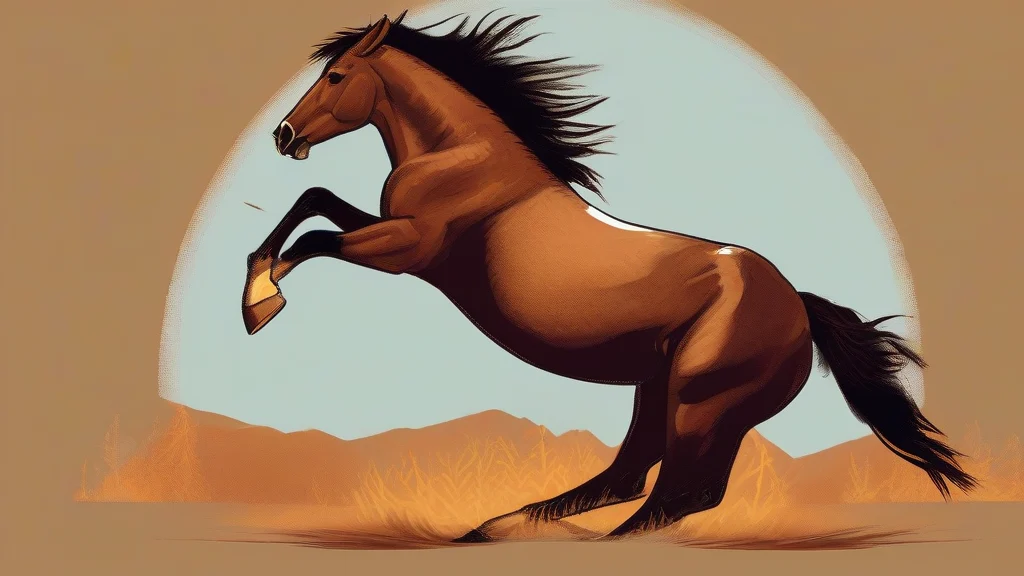
What does bronc mean?
A bronc is a wild or unbroken horse — one that resists being saddled or ridden and characteristically bucks in protest. The word is a familiar North American shortening of 'bronco', itself borrowed from Spanish, where 'bronco' originally meant rough or unruly. In modern usage 'bronc' is most closely tied to the world of rodeo: bronc riding is a headline event in which competitors must stay mounted on a deliberately difficult, bucking horse for a set time, usually eight seconds. Beyond the arena, the term can refer to any untamed range horse, evoking the open rangelands and ranching traditions of the American West. The register is informal and colorful, carrying connotations of toughness, risk, and frontier spirit. Related terms such as 'broncobuster', meaning someone who breaks horses, reinforce the word's place in Western vocabulary.
nounA wild or untamed horse, especially one that habitually bucks; chiefly a North American shortening of 'bronco', used especially in the context of rodeo.
- An untrained or wild horse that bucks, especially one used in rodeo bronc-riding events.
- Informally, any stubborn or hard-to-control horse.
"She held on through all eight seconds aboard a notoriously rank bronc."
"The young cowboy drew a rank bronc that had thrown every rider that season."
"Breaking a range-bred bronc took patience, a good saddle, and a fair amount of grit."
Regular plural; occasionally written 'broncoes' but this is nonstandard.
"Several rangy broncs were penned behind the chutes before the event began."
In rodeo, a bronc that has never been successfully ridden for the full eight seconds is so prized it gets its own reputation — and riders draw lots hoping to avoid it.
Reviewed by Deb Chak, Editor. AI-assisted content curated by RJS Tech Solutions LLP.
Etymology of bronc
Bronc originated in nineteenth-century North America as a clipping of 'bronco', a Spanish word meaning rough or rude that came to denote an unbroken horse in the American Southwest and Mexico. English adopted 'bronco' during the era of westward expansion and ranching, and the shortened 'bronc' arose among cowhands and later became standard rodeo terminology. Both forms remain in use today, with 'bronc' favored in rodeo contexts.
Related word forms
How bronc is actually used
Informal and colloquial, with strong associations with the American West and rodeo culture; 'bronco' is the fuller form and may sound slightly more formal. The plural is 'broncs'.
Easily confused with bronc
'Bronco' is the full word of which 'bronc' is simply an informal shortening; both mean an untamed, bucking horse.