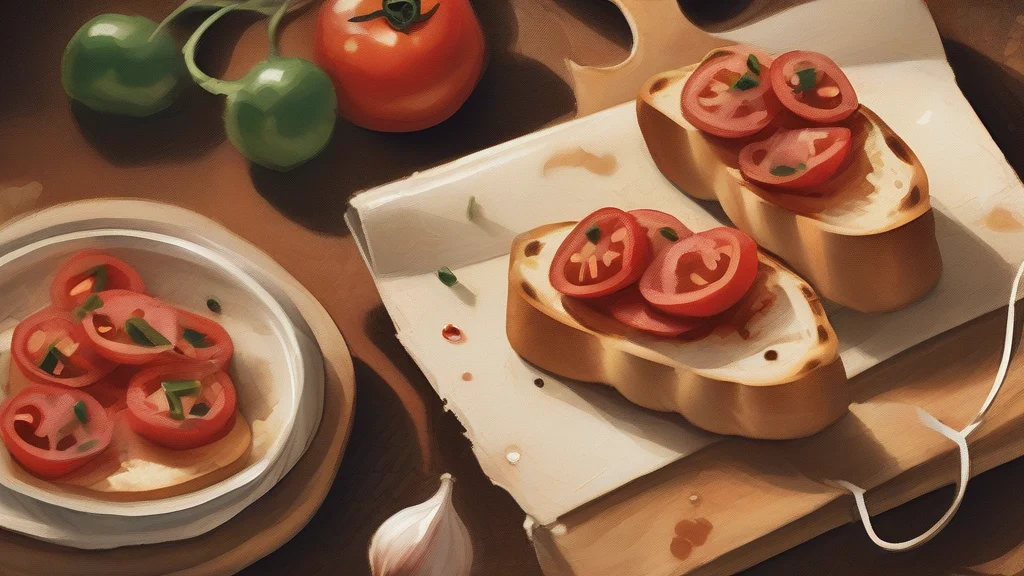
What does bruschetta mean?
Bruschetta is a traditional Italian appetizer consisting of thick slices of bread — ideally a rustic loaf such as sourdough or country bread — that are grilled or toasted until crisp, then rubbed while still warm with a cut clove of raw garlic and dressed with olive oil, salt, and pepper. Most famously, it is crowned with a topping of diced fresh tomatoes and basil, though countless variations exist, featuring beans, mushrooms, cured meats, or cheeses. Served at room temperature, it belongs to the family of Italian antipasti and appears on menus worldwide as a staple starter. The word comes from the Roman dialect verb bruscare, meaning 'to toast' or 'to roast over coals', which points to the dish's humble rural origins as a way of reviving day-old bread. Simple, seasonal, and deeply tied to good olive oil, bruschetta has come to symbolize the Italian knack for turning basic ingredients into something memorable.
nounAn Italian antipasto consisting of slices of bread that are grilled or toasted, rubbed with garlic, drizzled with olive oil, and typically topped with ingredients such as diced tomatoes, basil, or other savoury mixtures.
- A dish of grilled bread rubbed with garlic, topped with olive oil and usually tomatoes or other savoury toppings, served as an appetizer.
"We started the meal with a platter of tomato-and-basil bruschetta."
"The restaurant's menu opened with a classic bruschetta of crushed tomatoes, garlic, and torn basil on charred sourdough."
"For the party, she prepared three kinds of bruschetta: one with white beans, one with mushrooms, and one with ripe summer tomatoes."
The anglicized plural 'bruschettas' is standard in English, especially when referring to multiple servings or varieties; the Italian plural 'bruschette' also appears but is less common outside Italian culinary writing.
"She ordered two different bruschettas so everyone could try both toppings."
In Italy, saying it 'broo-sheh-tah' with a soft 'sh' marks you as a tourist — the authentic Italian pronunciation keeps the hard 'k' sound.
Reviewed by Deb Chak, Editor. AI-assisted content curated by RJS Tech Solutions LLP.
Etymology of bruschetta
Bruschetta was borrowed into English from Italian in the twentieth century as the dish spread beyond Italy's borders. It derives from the Roman dialect word bruschetta, a diminutive of brusca, ultimately from the verb bruscare, 'to toast or roast over embers'. This reflects the dish's origins as simple peasant food: stale bread revived over coals, perfumed with garlic and new olive oil. The Italian verb abbrustolire ('to toast') shares the same root, and the dish itself is closely allied to Spanish pan con tomate and French tartine, which arose from similar traditions.
How bruschetta is actually used
Borrowed directly from Italian, so it is fully naturalized in English but retains its Italian character; it functions as both a mass noun ('some bruschetta') and a countable one ('three bruschettas'). The plural 'bruschette' follows Italian grammar but is rare in everyday English.
Easily confused with bruschetta
Crostini are smaller, thinner slices of bread, often made from baguette and crisped in the oven, whereas bruschetta uses larger slices of rustic bread grilled over coals or toasted and rubbed with raw garlic.