What does brush mean?
A brush is one of the most familiar tools in daily life: an implement with bristles, wires, or fibres fixed into a handle, used for everything from cleaning floors and grooming hair to applying paint. Beyond the physical object, the word carries several figurative senses — a brush can be the lightest of touches, as in the brush of fingertips, or a brief, sharp encounter, as in 'a brush with danger' or 'a brush with the law'. In North America and Australia, brush also denotes dense shrubland or undergrowth. The verb form is equally versatile: you can brush your teeth, brush off criticism, or brush up on a language. This range makes brush a compact, high-frequency word whose meaning is almost always clear from context. Its many compounds — toothbrush, paintbrush, brushfire — show how deeply embedded it is in everyday English.
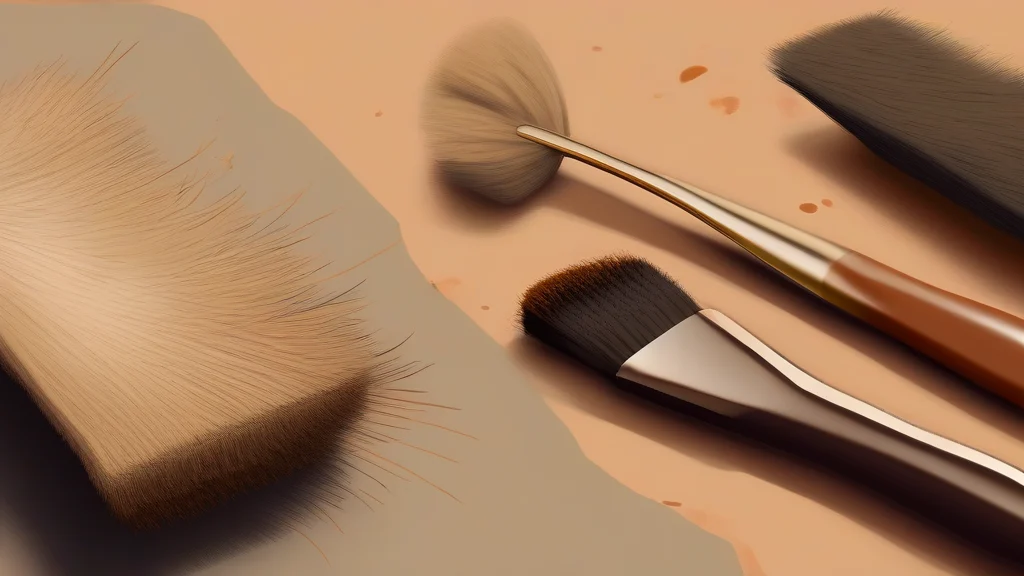
An implement with bristles or filaments attached to a handle, used for cleaning, grooming, painting, or applying a substance.
"She bought a new brush to repaint the kitchen cabinets."
Countable; commonly appears in compounds like toothbrush and paintbrush.
A light, brief touch or contact with something.
"He felt the brush of her sleeve as she passed."
A short, minor fight or hostile encounter.
"The patrol had a brush with enemy forces near the ridge."
Dense shrubs or small trees growing thickly; undergrowth.
"The trail disappeared into thick brush."
Chiefly North American and Australian usage.
Standard English plural, adding -es after the -sh ending.
"The studio was cluttered with jars of brushes and tubes of paint."
The same word that sweeps dust from your floor also names a brief skirmish — English borrowed it twice, from two different French words, and ended up with one spelling covering both.
Reviewed by Deb Chak, Editor. AI-assisted content curated by RJS Tech Solutions LLP.
Etymology of brush
The noun 'brush' entered Middle English in the fourteenth century, likely via Old French 'broisse' (or 'brosse'), referring to a brush made of twigs, ultimately connected to brushwood. A second borrowing from Old French 'bruissier' or related forms gave rise to the senses of touching lightly and a skirmish. The vegetation sense derives from the same idea of a thicket of brushwood. Cognates appear in Romance forms such as Spanish 'brocha' and Italian 'broccio'.
Related word forms
How brush is actually used
As a noun, 'brush' is countable in its tool sense but often uncountable when referring to vegetation. The verb sense is regular. In British English, 'brush past someone' is common for moving close by; American English more often uses 'brush by'. The phrase 'brush up on' means to refresh a skill.
Easily confused with brush
A brooch is a decorative jewellery pin fastened to clothing, while a brush is an implement with bristles for cleaning, grooming, or painting.