What does buckboard mean?
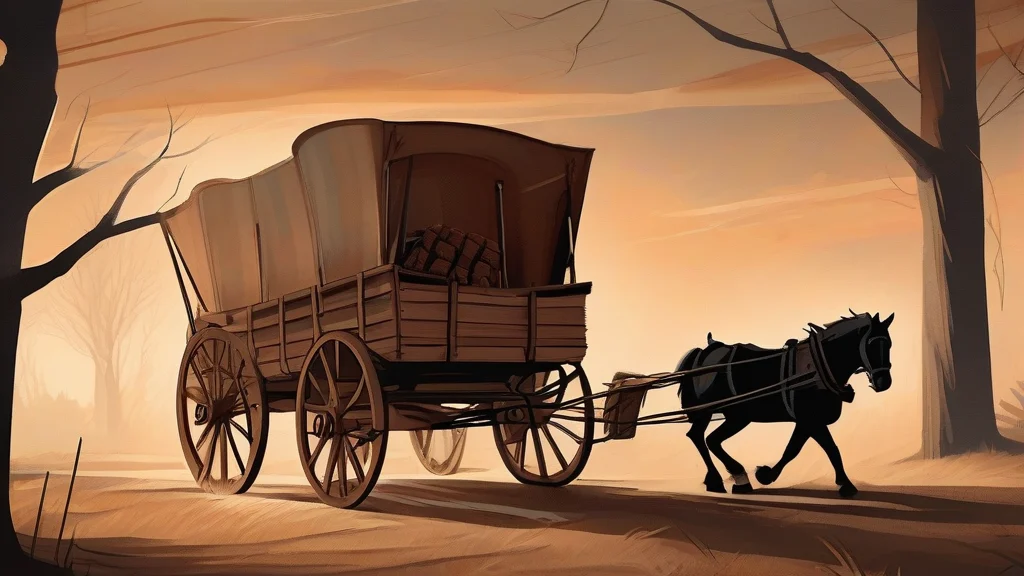
A buckboard is a light, four-wheeled, open wagon drawn by horses or mules, best known as a workhorse of rural nineteenth-century North America. Its defining feature lies in its construction: instead of a rigid box or enclosed body, it uses a platform of long boards stretched flexibly between the front and rear axles, giving the vehicle a springy, if jarring, ride over unpaved roads. Farmers, ranchers, and small-town merchants used buckboards to haul produce, supplies, and passengers, valuing them for being cheaper and lighter than more elaborate carriages. The word survives today largely in historical contexts — Western novels, museums, and accounts of pioneer life — where it evokes an era of dirt roads and horsepower. For modern readers, it is a vivid, concrete noun that instantly conjures images of the American frontier and everyday transport before the automobile age.
nounAn open, four-wheeled horse-drawn wagon with a flexible platform of boards connecting the front and rear axles, formerly used especially in North America for carrying goods and passengers over rough roads.
- A light, four-wheeled, open horse-drawn wagon whose floor consists of a flexible platform of boards mounted between the axles, used chiefly in 19th-century North America.
"The farmer loaded his buckboard with sacks of grain before dawn."
"They hitched the mule to the buckboard and set off across the prairie."
"In the museum's frontier exhibit, a weathered buckboard stood beside a collection of harnesses and saddles."
Regular plural; countable noun referring to multiple wagons of this type.
"Several buckboards were lined up outside the general store."
A buckboard has no actual 'body' at all — its floor is just a springy bed of boards slung between two axles, which is exactly what gave it its bouncy ride.
Reviewed by Deb Chak, Editor. AI-assisted content curated by RJS Tech Solutions LLP.
Etymology of buckboard
The word buckboard is an American compound formed from 'buck' and 'board', first appearing in the United States during the first half of the nineteenth century. The 'board' element refers plainly to the flexible plank platform that forms the vehicle's floor. The reason for 'buck' is less certain; a common account links it to the bumpy, jolting motion of the sprung boards, likened to the leaping of a bucking animal. It belongs to the large English family of 'board' compounds, such as blackboard and keyboard, all built on the ancient Germanic word 'board' meaning a flat plank or table.
How buckboard is actually used
The word is strongly associated with 19th-century rural North America and now carries a nostalgic, historical flavor; it appears mostly in historical writing, Western fiction, and descriptions of museums or reenactments rather than everyday speech.
Easily confused with buckboard
A stagecoach is a closed passenger coach running on scheduled routes, whereas a buckboard is a simple, open utility wagon with no fixed roof or enclosed body.