
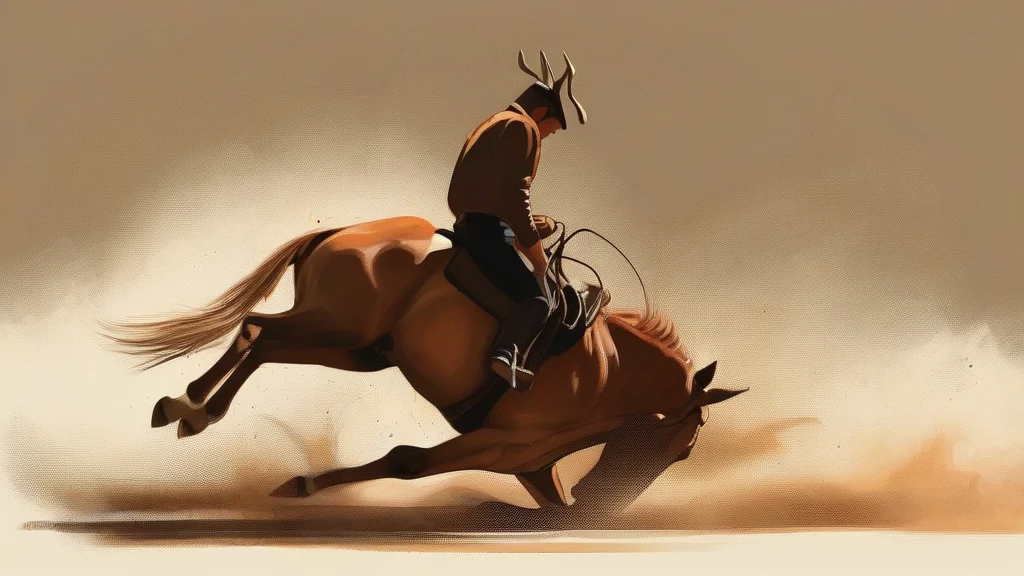
What does bucking mean?
Bucking is the present participle of the verb 'to buck', describing the sharp, arched-back leap that horses, bulls, and other animals perform — most famously when trying to unseat a rider. From this literal image comes a range of extended uses: vehicles and boats are said to buck when they jolt over rough ground or water, and people who are bucking a trend, a convention, or an expectation are resisting it head-on, much like the animal throwing off its rider. The word carries connotations of energy, defiance, and unruliness, which makes it vivid in journalism and everyday speech alike. It appears constantly in phrases such as 'bucking the trend', where it signals going against the prevailing current. In North American rodeo culture, 'bucking' is also used as a noun for the event itself, as in a bucking bronco competition. Derived ultimately from 'buck' — a male animal, especially a deer or goat — the word has long been tied to images of spirited resistance.
Present participle of 'buck': (of an animal, especially a horse) to jump with the back arched and legs stiffened, often to throw off a rider; more generally, to move jerkily or to resist forcefully.
"The colt came out of the gate bucking and kicking before settling into a smooth gallop."
Frequently used in progressive constructions ('is bucking', 'was bucking') and in the fixed phrase 'bucking the trend'.
The action or practice of bucking, especially as a spectacle in rodeo events involving horses or bulls.
"The crowd roared during the bareback bucking at last night's rodeo."
Chiefly North American and informal; usually heard within rodeo contexts.
A rodeo 'bronc' can be scored higher for bucking than for speed — the wilder the jump, the bigger the prize.
Reviewed by Deb Chak, Editor. AI-assisted content curated by RJS Tech Solutions LLP.
Etymology of bucking
Bucking derives from the verb 'buck', whose origins trace to the Old English and Germanic word for a male animal — compare Old English 'bucc' meaning a male goat or buck, cognate with Old Norse 'bokkr' and modern German 'Bock'. The animal sense gave rise to the verb describing the leaping motion characteristic of such animals, attested in English from around the sixteenth century. The figurative sense of resisting or opposing developed later, extending the physical image of an animal refusing control. Related forms appear across the Germanic languages, including Dutch 'bok' and German 'Bock'.
Related word forms
How bucking is actually used
As a verb form, 'bucking' is common in both literal equestrian contexts and figurative ones ('bucking expectations'). The standalone noun use ('the bucking') is largely confined to rodeo culture and is informal.
Easily confused with bucking
'Backing' means moving backwards or supporting something, while 'bucking' means jumping violently forward with an arched back or resisting.