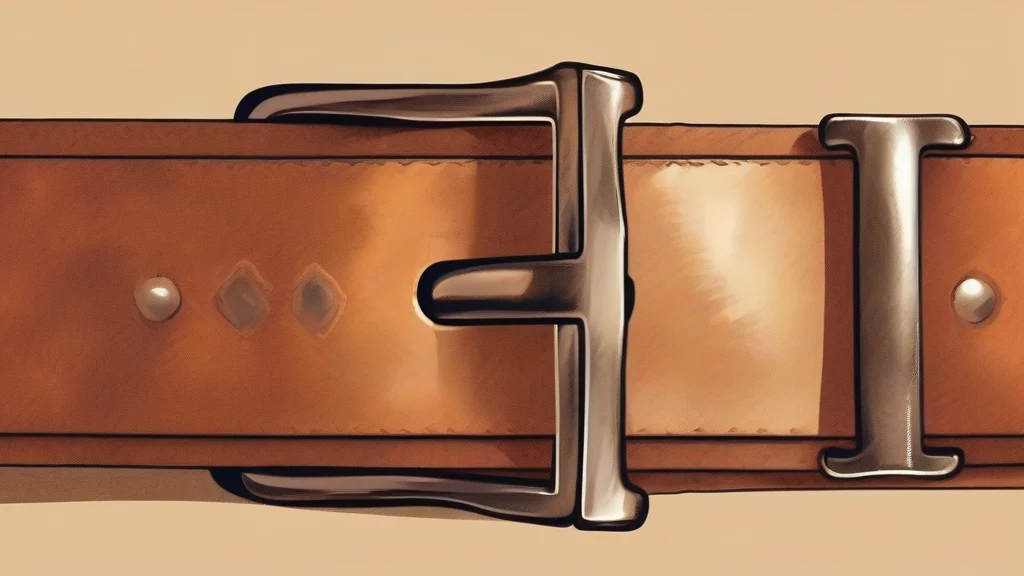
What does buckle mean?
Buckle functions as both noun and verb. The noun names the familiar flat, often metal or plastic fastener with a movable pin that secures one end of a strap to the other, found on belts, shoes, bags, and harnesses. The verb has two main uses: transitively, to fasten something with such a device ('she buckled her helmet'), and, more dramatically, to bend, warp, or give way under physical force ('the road buckled in the heat'). By extension, people too can buckle under pressure, meaning to succumb to stress or hardship. Two idioms are especially widespread: 'buckle down', meaning to settle seriously to work, and 'buckle up', the standard reminder to fasten a seatbelt. Derived from Latin buccula via Old French, the word is everyday vocabulary across English-speaking regions, equally at home in practical instructions and vivid figurative description.
A metal or plastic frame with a hinged pin, used to fasten the ends of a belt, strap, or shoe together.
"His belt buckle was engraved with his initials."
Plural: buckles.
To fasten or secure with a buckle; also, to bend out of shape or give way under pressure or strain.
"The scaffolding buckled when the storm hit."
Standard regular plural; applies only to the noun sense referring to fasteners.
"The antique trunk still had its original brass buckles intact."
The word 'buckle' traces back through Old French to Latin buccula — literally 'little cheek' — because of the strap's resemblance to a horse's cheek-strap.
Reviewed by Deb Chak, Editor. AI-assisted content curated by RJS Tech Solutions LLP.
Etymology of buckle
Buckle entered Middle English from Old French boucle, which itself derived from Latin buccula, a diminutive of bucca meaning 'cheek'. The term originally referred to the cheek-strap of a horse's harness before broadening to mean any strap fastener. The sense of bending or collapsing developed later, apparently by analogy with the warping of buckled material.
Related word forms
How buckle is actually used
In British and American English alike, 'buckle' is common in both literal (fastening) and figurative contexts; figuratively, it usually carries negative connotations of weakness or failure. The phrasal verbs 'buckle down' (to apply oneself seriously) and 'buckle up' (a safety instruction) are extremely common idioms.
Easily confused with buckle
To truckle means to submit or act in an obsequiously submissive way, whereas to buckle means to fasten or to collapse under strain.