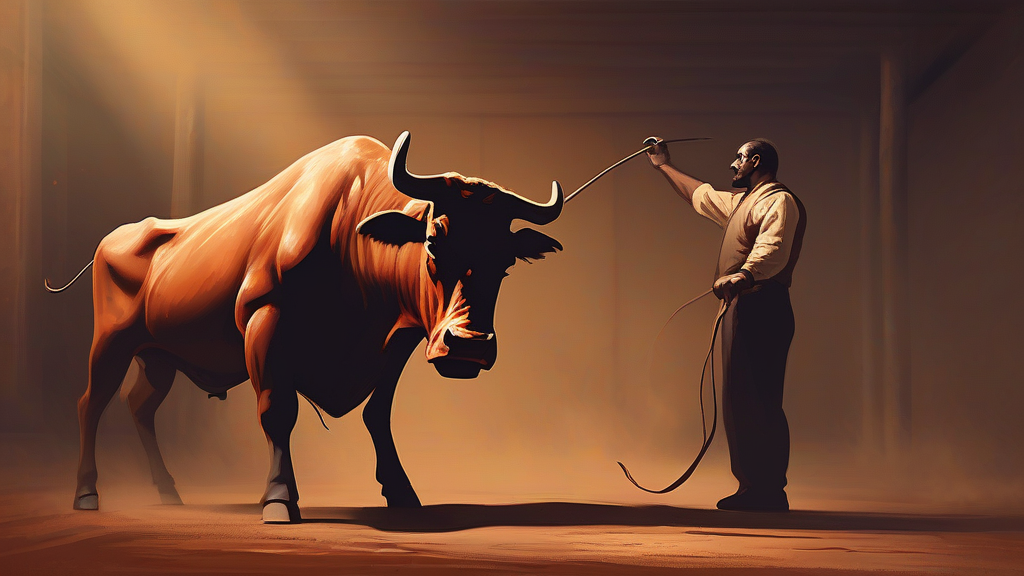
What does bullwhipping mean?
Bullwhipping refers to the act of striking something—or someone—with a bullwhip, the long, plaited whip developed for handling cattle, whose tapered design allows its tip to move fast enough to break the sound barrier and produce a sharp crack. The term functions chiefly as a noun describing this action, though it also covers whip-cracking as a practiced skill, seen in circus acts, rodeos, and competitive whip artistry. Because the bullwhip was historically used both to drive livestock and to inflict punishment, the word can carry harsh, even disturbing connotations when it appears in historical or figurative contexts. In everyday modern usage it is uncommon, surfacing mostly in writing about the American West, stunt work, or the niche sport of whip cracking, where precision and showmanship are prized.
nounThe act or practice of striking someone or something with a bullwhip, a long tapering whip that produces a sharp cracking sound.
- The act of striking a person, animal, or object with a bullwhip.
- The practice or performance art of skillfully wielding and cracking a bullwhip.
"The cattle driver's skillful bullwhipping kept the herd moving along the trail."
"In the old circus acts, bullwhipping demonstrations drew huge crowds eager to see the performer slice a paper target in two."
"Historians have documented the harsh bullwhipping of enslaved people on plantations as one of slavery's brutal instruments of control."
A skilled bullwhip handler can snap the tip past the speed of sound — the famous 'crack' is actually a tiny sonic boom, not the leather hitting anything.
Reviewed by Deb Chak, Editor. AI-assisted content curated by RJS Tech Solutions LLP.
Etymology of bullwhipping
Bullwhipping derives from bullwhip, a compound of 'bull' (an adult male cattle animal, extended to cattle generally) and 'whip', formed in nineteenth-century America where such whips were used to drive oxen and cattle. The word 'whip' itself is of uncertain ultimate origin but appears in Middle English, likely of Germanic stock, giving rise to relatives such as whipcord and whiplash. The gerundial form bullwhipping follows the ordinary English pattern of forming action nouns from verbal stems.
Related word forms
How bullwhipping is actually used
The word is relatively rare outside contexts involving livestock handling, circus or stunt performance, historical accounts of corporal punishment, and whip-cracking as a hobby or sport. When applied to striking people, it carries strongly negative connotations tied to violence and coercion.
Easily confused with bullwhipping
A bullwhip is the long whip itself, while bullwhipping is the act or action of striking with one.
Whipping is a general term for striking with any whip, whereas bullwhipping specifically involves a bullwhip.