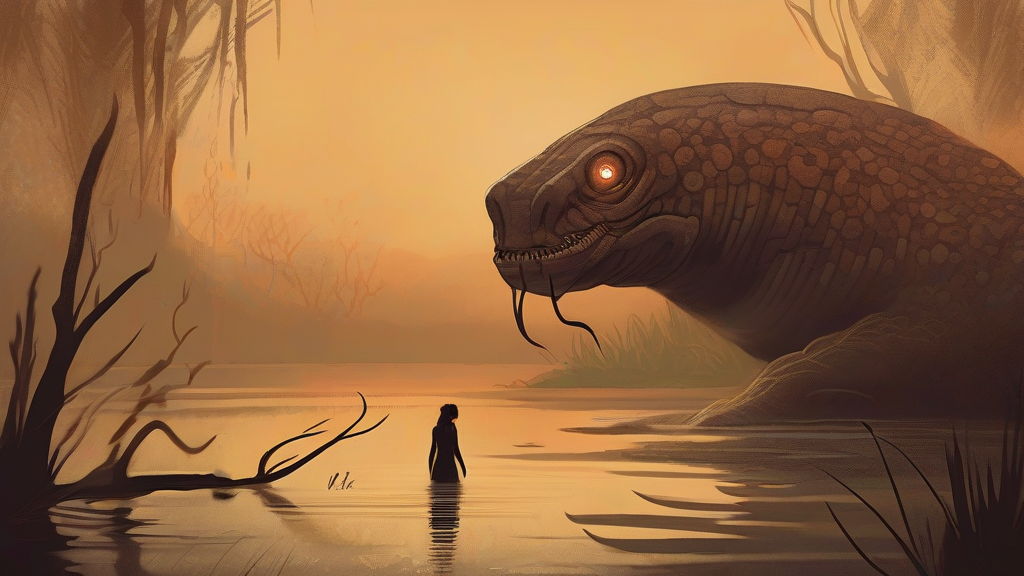
What does bunyip mean?
A bunyip is a creature from the mythology of Aboriginal peoples of south-eastern Australia: a fearsome spirit or monster believed to dwell in swamps, creeks, and other bodies of water, where it was said to devour unwary travellers. The name entered English through Australian Aboriginal languages during the colonial period, and European settlers in the nineteenth century eagerly reported supposed sightings and produced contradictory descriptions of the beast, making the bunyip one of Australia's best-known legendary creatures. Beyond its mythological sense, the word has developed a figurative use in Australian English to mean an imaginary monster or a fabricated threat invented to frighten people — calling something a bunyip implies it does not really exist. The term appears most often in discussions of folklore, cryptozoology, and Australian history, including the famous political phrase "bunyip aristocracy", coined in 1853 to mock proposals for an Australian hereditary upper house. It remains a distinctly Australian word, rich with local colour.
A legendary water monster or evil spirit in Aboriginal Australian mythology, said to haunt swamps and waterholes.
"The old-timers warned the children never to swim alone, for fear of the bunyip."
Capitalisation varies; lowercase is standard in dictionaries.
(Australian, figurative) An imaginary monster or fictitious threat invented to frighten people.
"Critics called the government's new scare campaign nothing but a bunyip."
Regular plural; used when referring to multiple creatures or instances of the mythical being.
"Different tribes told different tales about the appearance of the bunyips."
Australia's most famous monster lives in the water — and its name was borrowed from an Aboriginal language so long ago that most Australians forget it wasn't always English.
Reviewed by Deb Chak, Editor. AI-assisted content curated by RJS Tech Solutions LLP.
Etymology of bunyip
The word "bunyip" derives from the Wemba-Wemba (Wergaia) language of Aboriginal peoples of north-western Victoria, where it referred to a devil or evil spirit. It was adopted into Australian English during the early decades of European settlement in the region, first appearing in print in the 1840s as settlers reported alleged sightings of the creature. It is unrelated to any Indo-European root, so it has no true cognates outside Australian Aboriginal languages.
How bunyip is actually used
The word is strongly associated with Australia and is chiefly used there. In extended use it carries a dismissive connotation, implying that the thing described is imaginary or fraudulent. The phrase "bunyip aristocracy" (coined by Daniel Deniehy in 1853) refers satirically to a would-be hereditary elite in Australia.
Easily confused with bunyip
The yowie is a purported ape-like hominid said to live in the Australian bush, while the bunyip is a water-dwelling creature of Aboriginal legend.