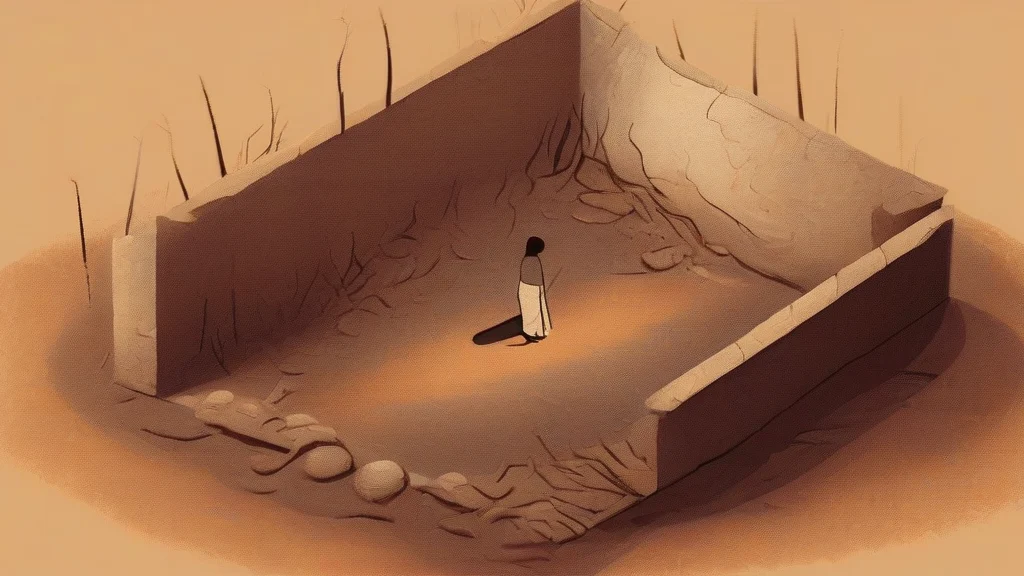
What does buried mean?
Buried is the past tense and past participle of the verb 'to bury' and describes the act of having placed something, especially a body, into the ground or beneath a covering. It also works as an adjective, describing anything fully covered or hidden — from literal instances like buried pipes and buried treasure to figurative ones such as buried memories or buried emotions. In everyday speech, people say they are 'buried in work' to convey being overwhelmed, and the phrase 'dead and buried' emphasizes finality, while 'bury the hatchet' signals reconciliation between former opponents. The word's tone ranges from solemn, when referring to funerals and gravesites, to vividly metaphorical in business and emotional contexts. Because it spans concrete and abstract uses so naturally, 'buried' remains one of English's most versatile verbs, useful in everything from archaeology reports to casual conversation.
Past tense and past participle of 'bury': to have placed something underground or in a grave, or to have hidden or covered it completely.
"The villagers buried their dead after the flood."
Also appears in perfect and passive constructions, e.g. 'has been buried', 'was buried at sea'.
Covered or hidden beneath something, either literally or figuratively.
"The crew finally reached the buried pipeline."
Commonly used figuratively, e.g. 'buried treasure', 'buried feelings', 'buried in work'.
In English, 'bury' and 'borough' come from the same ancient root — a fortified place — which is why so many English towns literally named 'Bury' sit on old defensive sites.
Reviewed by Deb Chak, Editor. AI-assisted content curated by RJS Tech Solutions LLP.
Etymology of buried
The verb 'bury' descends from Old English 'byrgan' (also 'burian'), meaning to inter a corpse, which itself derives from Proto-Germanic '*bergan', a verb associated with protecting and concealing. The same Germanic root produced Old English 'burh' or 'burg', meaning a fortified settlement, whose descendants survive today as 'borough' in Britain and 'burg' in American place names. This shared ancestry links the everyday act of burying to the naming of countless towns across the English-speaking world.
Related word forms
How buried is actually used
'Buried' functions both as a finite past-tense verb and as a past participle used in perfect tenses and passive constructions ('was buried'). As an adjective it commonly appears attributively ('a buried pipe', 'buried treasure') and figuratively ('buried feelings', 'buried in work'), where it carries connotations of suppression or overwhelming immersion. The figurative senses are standard in informal as well as formal register.
Easily confused with buried
'Berry' is a small fruit (or the verb meaning to bear such fruit), while 'buried' means placed underground or hidden — the two sound similar in some dialects but share no meaning.