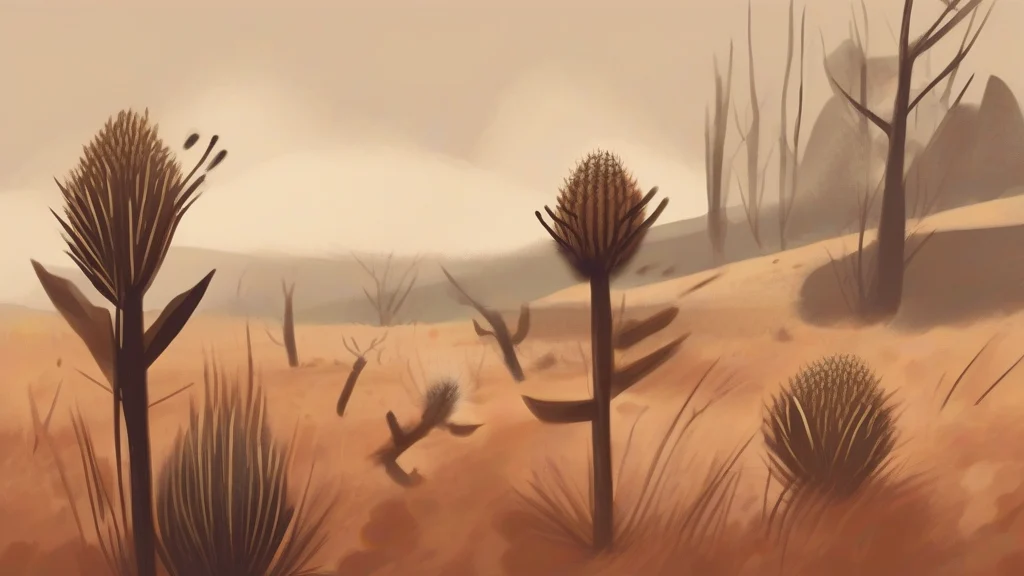
What does burry mean?
Burry is an adjective with two related-by-form but distinct senses. Its primary and oldest sense describes something covered in, or full of, burs — the small prickly seed cases produced by plants such as burdock, which cling tenaciously to fabric, fur, and wool. A farmer might describe a dog returning from a walk through rough pasture as hopelessly burry. The second sense applies to speech: a burry voice or accent is one with a strongly rolled or guttural 'r', a quality famously associated with Northumbrian and certain Scottish dialects, where the sound itself is called a burr. The word is informal to neutral in register, appearing mostly in descriptive or literary contexts rather than technical ones. Compact and vivid, it offers writers a precise alternative to vaguer terms like 'prickly' when describing both tangled vegetation and distinctive regional speech.
Covered in, bearing, or full of burs (prickly seed cases that cling to fur, wool, or fabric).
"His woollen sweater was so burry after the hike that he spent the evening picking seed cases off it."
This is the original and still dominant sense of the word.
(Of an accent or voice) characterized by a strong, rolling, or guttural pronunciation of the letter 'r'.
"Her burry delivery gave the ballad an unmistakable air of the northern hills."
Derived from the noun 'burr' for the rolled 'r'; especially associated with Northumbrian speech.
The same word can describe what clings to your trousers after a country walk — and the rolling 'r' of a Northumbrian shepherd's accent.
Reviewed by Deb Chak, Editor. AI-assisted content curated by RJS Tech Solutions LLP.
Etymology of burry
Burry was formed in English from the noun 'bur' (also spelled 'burr') — a Middle English word, likely of Scandinavian origin, denoting a prickly seed head — combined with the common adjectival suffix '-y'. The word has been used since at least the early modern period to describe things covered in these clinging seed cases. The sense relating to speech arose later, derived figuratively from the noun 'burr' when it came to denote the rough, rolled 'r' sound characteristic of Northumbrian and some Scottish accents. Related forms include the nouns 'bur', 'burr', and the compound 'burdock', the plant whose seed heads are the archetypal bur.
How burry is actually used
The 'covered in burs' sense is the older and more literal use. The accent sense derives figuratively from the noun 'burr' for the rolled 'r' sound, most famously associated with Northumbrian and some Scottish speech. Both uses are informal to neutral; neither is common in formal writing.
Easily confused with burry
Burrow is a noun or verb referring to a hole dug by an animal or the act of digging one, while burry is an adjective meaning covered in prickly burs.
Blurry means out of focus or indistinct, whereas burry means covered in burs or having a rolled 'r' in speech.