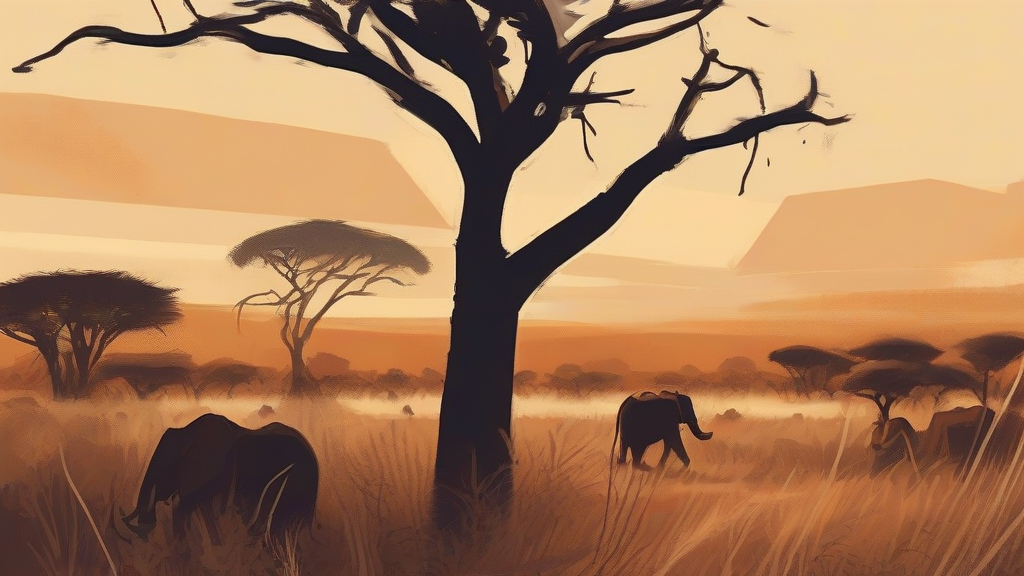
What does bushveld mean?
Bushveld is a noun originating in Afrikaans that describes the distinctive open woodland savanna covering large areas of southern Africa. Combining 'bush' and 'veld' (field or open country), the term names terrain characterized by mixed grassland dotted with trees and shrubs such as acacia, marula, and mopane. Ecologists recognize several subtypes, including sour bushveld and sweet bushveld, distinguished by soil type and grazing quality. In everyday use, particularly in South African English, the word evokes the landscapes of Limpopo, Mpumalanga, and North West provinces, and it is closely tied to safari culture: many famous game reserves, including parts of Kruger National Park, lie in bushveld country. Beyond its ecological meaning, bushveld connotes a sense of wild, unspoiled African wilderness, making it a resonant term in both scientific writing and popular descriptions of the region's natural beauty.
nounThe grass- and scrub-covered open woodland terrain characteristic of much of inland southern Africa, especially the northeastern parts of South Africa. The term also refers collectively to the region itself.
- A type of sub-tropical woodland savanna vegetation found across southern Africa, characterized by mixed grassland with scattered trees and shrubs such as acacia and marula.
- By extension, the geographical region or countryside covered by this vegetation type, often used to refer to rural areas of northern South Africa.
"The safari lodge sits on a ridge overlooking miles of rolling bushveld."
"Lions and elephants roam freely across the vast bushveld of Kruger National Park."
"After the summer rains, the bushveld turns a brilliant green almost overnight."
Rarely pluralized; the singular typically suffices because the term denotes a broad region or continuous vegetation type rather than discrete units. Plural forms appear occasionally when comparing distinct regional variants.
"Ecologists distinguish between the moist bushvelds of the lowveld and the drier types further west."
The word 'bushveld' comes straight from Afrikaans — literally 'bush field' — and it names the landscape where some of Africa's most famous safaris unfold.
Reviewed by Deb Chak, Editor. AI-assisted content curated by RJS Tech Solutions LLP.
Etymology of bushveld
Bushveld derives from Afrikaans, in which it is a compound of 'bos' (bush) and 'veld' (field or open country). The component 'veld' itself comes from Middle Dutch 'velt', cognate with English 'field', both tracing back to Proto-Germanic roots for open land. The compound was adopted into South African English during the colonial era as settlers described the interior landscape, and it has since become a standard term in ecology and geography for this vegetation biome.
How bushveld is actually used
Bushveld is chiefly used in South African English and carries strong associations with safari tourism, game reserves (notably Kruger), and rural northern South Africa. It is a well-established geographic and ecological term internationally, appearing frequently in wildlife documentaries and travel writing. The plural form is rarely used since the word usually refers to an unbounded region or vegetation type rather than a countable entity.
Easily confused with bushveld
Veld is a broader Afrikaans term for any open, uncultivated grassland or field in southern Africa, while bushveld specifically denotes wooded or bushy savanna terrain.