
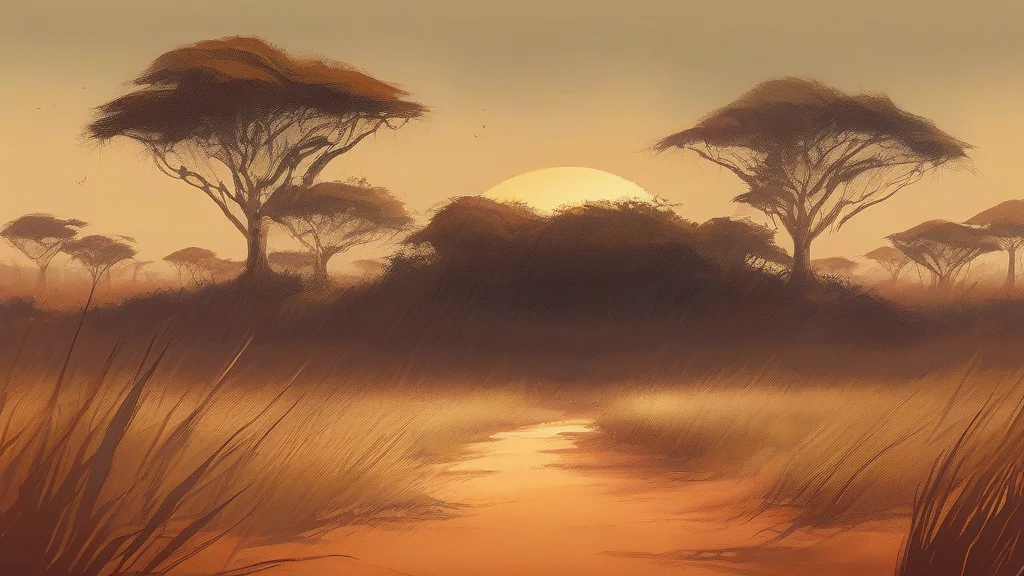
What does savanna mean?
A savanna is a broad grassland with few trees, usually found in tropical or subtropical climates and supported by seasonal rainfall. Savannas contain grasses, scattered trees such as acacias, and distinctive communities of grazing animals and predators, including zebras, giraffes, lions, and many birds. In geographical and ecological writing, “savanna” may refer not only to the visible grassland but to the entire biome, including its soil, plant communities, climate, and wildlife. Although savannas resemble other open grasslands, the word is most strongly associated with warmer regions, particularly in Africa, South America, and Australia. The term is also used more narrowly for individual stretches of treeless grassland. It is especially useful when describing a landscape defined by its grasses, scattered trees, and regular seasonal changes rather than by dense forest or desert vegetation.
nounA wide, generally treeless grassland, especially one occurring in tropical or subtropical regions. The term may also denote the biome more broadly, including its grasses, scattered trees, and associated wildlife.
- An open grassland with few trees, especially in a tropical or subtropical region.
- A biogeographic region characterized by grasslands, scattered trees, and seasonal rainfall.
"After the first rains, herds of wildebeest crossed the savanna in search of fresh grass."
"The river floodplain supports a rich savanna ecosystem."
"Acacia trees are scattered across the dry savanna."
The plural is formed by adding -s and is used for individual grasslands or regions of savanna.
"The African savannas support some of the world's largest migrations of grazing animals."
The word “savanna” entered English through Spanish and preserves a trace of the Indigenous Caribbean languages in which the concept of tropical grassland was first named.
Reviewed by Deb Chak, Editor. AI-assisted content curated by RJS Tech Solutions LLP.
Where does savanna come from?
The English word came from Spanish savana, which was borrowed from a Taíno word associated with open grassland in the Caribbean. Spanish passed the term into several European languages, producing forms such as French savane and Portuguese savana. The precise history of the original Indigenous word is not completely certain, but modern English retained both the Spanish form and the final schwa heard in its established pronunciation.
How savanna is actually used
Savanna is used mainly for tropical and subtropical grasslands. In British and American usage it is commonly pronounced with a final schwa, /səˈvænə/; the spelling savannah is an accepted variant.
Easily confused with savanna
Savannah is a variant spelling of savanna; it is also the conventional spelling of the city and port in Georgia, United States.