
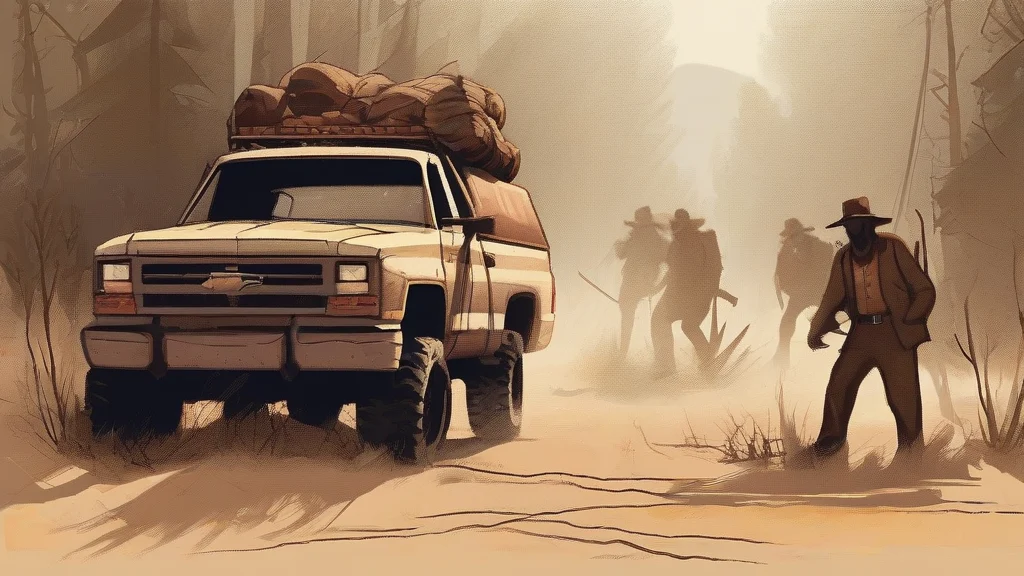
What does bushwhacker mean?
A bushwhacker is, at its core, someone associated with the bush — either a person who lives and travels through wild, uncleared backcountry, or, more darkly, a fighter who ambushes opponents from concealment rather than engaging in open battle. The word's most famous bearers were the Confederate guerrillas of the American Civil War, whose irregular tactics along the Missouri-Kansas border gave 'bushwhacker' a lasting association with ambush and lawlessness. Beyond that violent chapter, the term has long been used more neutrally for frontiersmen, prospectors, and settlers at home in remote terrain, particularly in Australia and rural America. Informal in register and vividly evocative, the word suits both historical writing about guerrilla conflict and descriptive prose about rugged outdoor life, though writers should be mindful of its charged Civil War connotations when using it in an American context.
A guerrilla fighter who ambushes from concealment, especially a Confederate irregular during the American Civil War; or a person who lives or travels through remote bush country.
"The bushwhackers melted into the undergrowth before the patrol could return fire."
In American historical writing, the term most often refers specifically to pro-Confederate guerrillas in Missouri and Kansas.
An inhabitant of, or traveler through, wild or unsettled backwoods region; a backwoodsman.
"Every bushwhacker in the territory seemed to pass through his trading post eventually."
Standard plural; used both for groups of guerrilla fighters and for communities of backwoodsmen.
"The raid was blamed on local bushwhackers operating out of the river hills."
During the Civil War, 'bushwhacker' was such a loaded word that being called one could get you shot on sight — yet today it just sounds like someone who enjoys hiking in the woods.
Reviewed by Deb Chak, Editor. AI-assisted content curated by RJS Tech Solutions LLP.
Etymology of bushwhacker
The word combines 'bush,' from Middle English and ultimately Old Norse 'buskr' meaning woodland or shrubbery, with 'whacker,' from the verb 'to whack,' meaning to strike. It emerged in nineteenth-century American English, first describing people who made their way through dense bush country, then taking on its guerrilla sense during the Civil War era when irregular fighters were said to 'whack' their victims from behind the bushes. The related verb 'bushwhack' developed alongside the noun, and the compound reflects the same pattern as other frontier terms built on 'bush.'
How bushwhacker is actually used
The term carries strong historical weight in American usage because of its association with Civil War–era guerrilla warfare in Missouri, Kansas, and other border states, where it often implied lawlessness and brutality. In Australian and rural American contexts, the word is more neutral, simply describing someone accustomed to rough bush country. Register is informal to neutral.
Easily confused with bushwhacker
The noun 'bushwhacker' names a person, while 'bushwhacked' is the past-tense verb meaning ambushed or attacked from hiding.