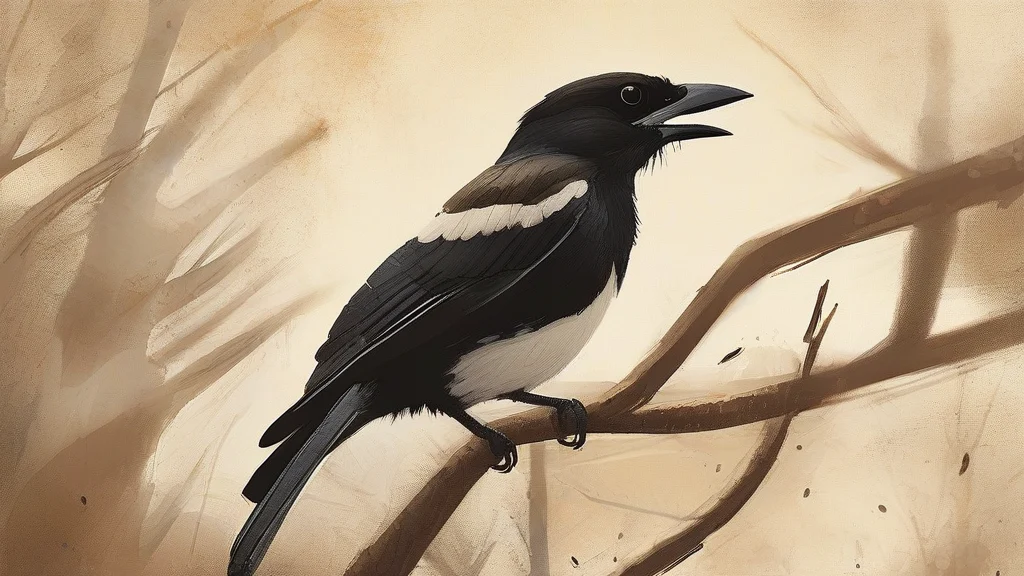
What does butcherbird mean?
A butcherbird is a songbird named for its unsettling habit of storing surplus food by impaling it on thorns, barbed wire, or wedging it into tree crevices — a practice reminiscent of a butcher hanging meat. The name applies most properly to Australasian birds of the family Artamidae, particularly the grey and pied butcherbirds of the genus Cracticus, which are among Australia's finest singers despite their carnivorous habits. In Britain and parts of Africa the same vernacular label was historically applied to shrikes, unrelated Old World birds sharing the same gruesome feeding technique. The word combines 'butcher' with 'bird' and dates from at least the seventeenth century. Because the term spans two unrelated groups of birds depending on region, careful writers specify the species or use the formal ornithological name when precision matters. The contrast between the butcherbird's beautiful song and its macabre table manners makes it a memorable subject in both science and folklore.
A songbird of the Australasian family Artamidae (genera Cracticus and related genera), known for impaling prey on thorns or wedging it in crevices and prized for its melodious call.
"A grey butcherbird perched on the veranda rail, singing a phrase more complex than any other bird in the garden."
In Australia this is the primary referent; the plural is regular ('butcherbirds').
Informal British name for a shrike (family Laniidae), an unrelated bird with the same habit of impaling prey on thorns.
"Victorian naturalists called the red-backed shrike the butcherbird for its thorn-hung larders."
This sense is chiefly historical or regional in Britain; modern ornithology uses 'shrike'.
Standard regular plural; used both for multiple individuals of one species and for members of the group generally.
"Pied butcherbirds often sing in duets or small choirs at dawn."
Despite its sweet, flute-like song, the butcherbird stores spare food on thorns and barbed wire like a tiny feathered executioner — hence the name.
Reviewed by Deb Chak, Editor. AI-assisted content curated by RJS Tech Solutions LLP.
Etymology of butcherbird
The word 'butcherbird' is an English compound formed from 'butcher', meaning one who slaughters animals for food, plus 'bird', first attested in English in the early seventeenth century. It arose as a vernacular descriptive name for birds observed hanging captured insects or small vertebrates on thorns as a butcher hangs meat. The same compound was independently applied to unrelated birds in different regions: to the Australasian cracticids, where it remains the standard common name, and earlier to European and African shrikes, whose formal family name Laniidae derives from Latin 'lanius', meaning butcher. Cognate constructions appear in other European languages, such as German 'Würger', from a verb meaning 'to strangle', reflecting parallel naming traditions.
How butcherbird is actually used
The term is informal and regionally variable: in Australia and New Guinea it denotes cracticid songbirds, while in Britain it traditionally refers to shrikes. Ornithological literature prefers the precise family or species name over the vernacular 'butcherbird'. The word carries a mildly macabre connotation owing to the bird's food-storage behaviour, contrasting sharply with its celebrated musical voice in Australian culture.
Easily confused with butcherbird
Shrike is the formal ornithological name for the Old World birds of the family Laniidae, which are called 'butcherbirds' colloquially in Britain and Africa, whereas 'butcherbird' properly refers to the unrelated Australasian cracticid songbirds.
The pied butcherbird is often mistaken for the Australian magpie, but it belongs to a different genus and has a black throat patch and different song.