
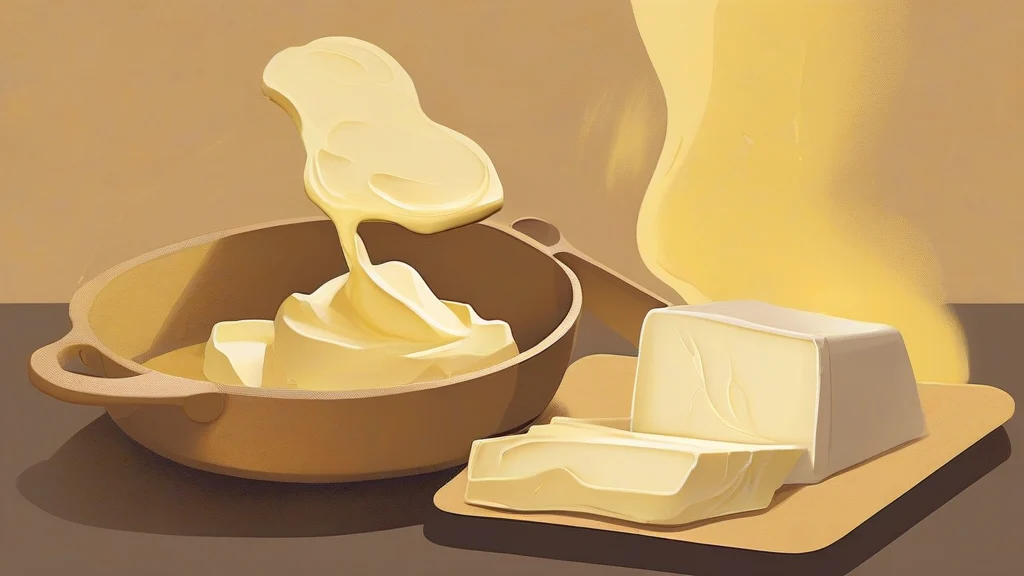
What does butter mean?
Butter is a soft, pale-yellow solid made by churning cream or milk, separating the fat globules from the liquid buttermilk. It has been a staple of European and South Asian cooking for millennia, prized both as a table spread for bread and toast and as an essential cooking fat that lends richness, flavour, and browning to baked goods, sauces, and sautés. The word also functions as a verb — 'to butter' means to coat food with butter — and gives rise to familiar idioms such as 'bread and butter', denoting a person's basic livelihood, and 'to butter someone up', meaning to flatter insincerely. Closely related words include 'butterscotch' and 'peanut butter', which borrow the name for texture or association rather than true dairy content. Because it is largely saturated fat, butter carries some health connotations, yet it remains a symbol of comfort, indulgence, and traditional home cooking across much of the world.
A soft yellowish-white solid emulsion of fat, made by churning cream or milk, used as a spread and as a cooking and baking fat.
"Add two tablespoons of melted butter to the batter."
To spread, coat, or cook with butter.
"Butter the pan lightly before pouring in the pancake mixture."
Almost always used with reference to food; figurative use is limited to idioms such as 'butter up'.
Rarely needed except when referring to multiple distinct types or varieties of butter.
"The shop stocked several artisanal butters from local dairies."
The word 'butter' comes from Greek boutyron — literally 'cow cheese' — and the phrase 'butter up' to flatter someone may come from the ancient practice of anointing people with butter like ointment.
Reviewed by Deb Chak, Editor. AI-assisted content curated by RJS Tech Solutions LLP.
Etymology of butter
Butter entered English via Old English 'butere', borrowed from West Germanic forms ultimately deriving from Latin 'butyrum', itself taken from Greek 'boutyron', literally 'cow cheese' (from bous, cow). The word thus reflects the product's journey westward through the Mediterranean into northern Europe, where butter became a dietary staple. Scientific terms such as 'butyric acid' preserve the same classical root, named for its occurrence in rancid butter.
Related word forms
How butter is actually used
As a verb, 'butter' is almost exclusively used with food contexts. In British English, 'buttery' also names a storeroom for provisions, especially at Oxford and Cambridge colleges. The countable plural 'butters' exists mainly for varieties of spread.
Easily confused with butter
Margarine is a vegetable-oil-based spread invented as a cheaper substitute, whereas butter is churned dairy fat from milk or cream.
A buttress is an architectural structure that supports a wall, unrelated to the edible spread despite the similar opening letters.