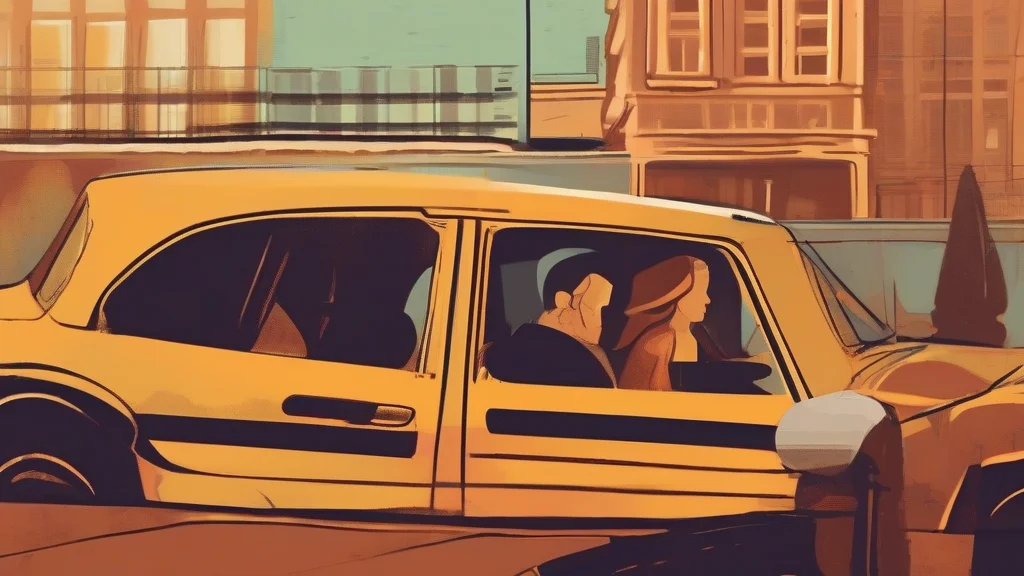
What does cabbed mean?
Cabbed is the past tense and past participle of the informal verb 'to cab', which means to travel by taxi or other hired vehicle. When people say they 'cabbed home' or 'cabbed it to the airport', they mean simply that they took a cab rather than driving themselves, walking, or using public transport. The word belongs firmly to casual conversation rather than formal writing, where phrases like 'took a taxi' or 'travelled by taxi' would be more typical. It pairs naturally with colloquial constructions such as 'cabbed it', a common idiom for making a journey by taxi. The underlying noun 'cab' is itself a shortened form of 'cabriolet', the two-wheeled horse-drawn carriage introduced in early nineteenth-century France, whose name derives from the Latin 'caper', meaning goat, via the French 'cabriole'. That same root gives us related words such as 'capriole' and 'Capricorn'. Though modest in scope, 'cabbed' captures a distinctly modern urban habit and remains a convenient, widely understood way to describe a taxi ride in everyday English.
verbCabbed is the simple past tense and past participle of the verb 'cab', meaning to travel somewhere by taxi or hired cab.
- To have travelled by taxi or hired car ('we cabbed across town').
- To have driven a taxi or truck for a living in informal use ('he cabbed in New York for years') — less common.
"We cabbed home after the concert because the last train had already left."
"After the flight was delayed, she cabbed into the city instead of waiting for the bus."
"They cabbed it back to the hotel because none of them wanted to walk another mile."
Every time you say you 'cabbed' somewhere, you're using a word that started life as a French carriage whose name literally traces back to a goat — the 'cabriolet' was named for its light, springy motion, from Latin caper, meaning goat.
Reviewed by Deb Chak, Editor. AI-assisted content curated by RJS Tech Solutions LLP.
Etymology of cabbed
The verb 'to cab' arose as a natural derivative of the noun 'cab', itself an abbreviation of 'cabriolet', a light two-wheeled French horse-drawn carriage popular from the early nineteenth century onward. The French 'cabriolet' comes from 'cabriole', referring to a leaping motion, ultimately from Latin 'caper', meaning goat. The derived verb appeared once taxis replaced horse-drawn hansom cabs, and 'cabbed' has served as its standard past form ever since.
Related word forms
How cabbed is actually used
Informal register. The phrase 'cabbed it' is especially common in casual American and British speech. As the past form of 'cab', it is rarely used in formal writing, where 'took a taxi' is preferred.
Easily confused with cabbed
'Capped' means sealed or covered with a cap or given a maximum limit, while 'cabbed' means travelled by taxi — they differ only in one letter but are entirely unrelated.