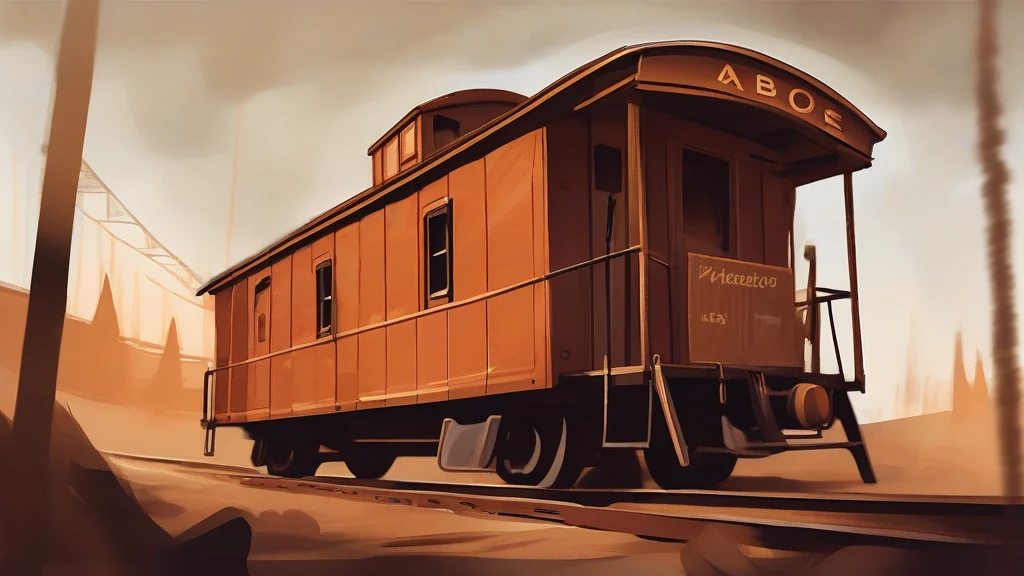
What does caboose mean?
A caboose is a specialised railway car coupled at the end of a freight train, serving as an office and living quarters for the train's crew — typically the conductor and brakemen. Fitted with windows, bunks, and often a raised cupola for watching over the cars ahead, it became one of the most recognisable symbols of North American railroading, so much so that 'bringing up the caboose' entered everyday speech as a way of describing anything at the very end of a line. The word has older nautical roots: on sailing ships, a caboose was the compact galley where meals were cooked. Today, with electronic monitoring having replaced the need for a crewed rear car, cabooses have largely vanished from service, surviving mainly on heritage railways and in nostalgic usage. The word also survives informally in American English as a playful term for the buttocks.
A railway car, usually the last on a freight train, providing accommodation and workspace for the train crew.
"From the cupola of the caboose, the brakeman watched for hot boxes on the wheels behind."
Primarily a North American term; the equivalent British vehicle was called a brake van or guard's van.
On a ship, a small galley or cookhouse, especially on smaller vessels.
"The cook prepared salt beef in the cramped caboose below deck."
This is now a historical or specialist nautical usage.
(Informal) A person's buttocks.
"After the long sled ride, his caboose was thoroughly chilled."
Humorous and informal; chiefly American English.
Standard plural; used when referring to multiple crew cars or ships' galleys.
"The museum yard displayed a row of brightly painted cabooses from different railroads."
Before it ever rolled on rails, a caboose was a ship's kitchen — the word hopped from a Dutch cooking stove to the back of American freight trains.
Reviewed by Deb Chak, Editor. AI-assisted content curated by RJS Tech Solutions LLP.
Etymology of caboose
The word caboose entered English in the mid-eighteenth century as a nautical term for a ship's galley or cookhouse, borrowed from Dutch 'kombuis', which denoted the kitchen area of a vessel. As railroads spread across North America, the term was transferred to the crewed car at the rear of a freight train, a sense well established by the nineteenth century. The Dutch source reflects a wider Germanic lineage of shipboard cooking terminology, though English retains few direct cognates.
How caboose is actually used
The railway sense is standard in North America; British English historically preferred terms such as 'guard's van' instead. The slang sense for buttocks is informal and humorous, best avoided in formal writing.