
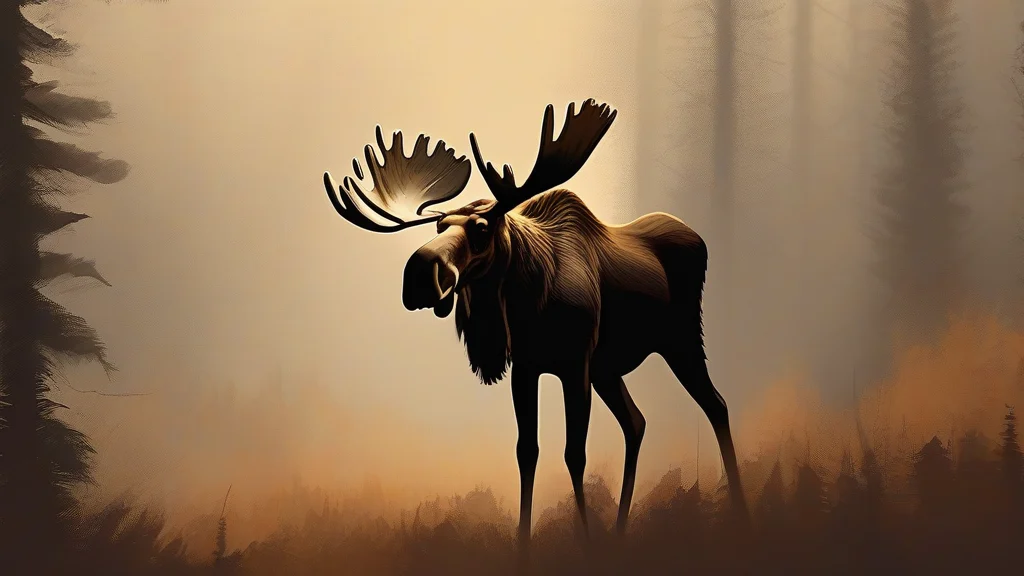
What does moose mean?
A moose is the largest living species of deer and one of the most distinctive animals in northern North America. It has a heavy body, long slender legs, a broad muzzle, and a conspicuous hanging dewlap. Adult males, called bulls, grow broad, flattened antlers that can extend roughly 1.8 metres across, while females generally lack antlers. Moose inhabit forests, wetlands, and tundra across Canada, Alaska, and the northern United States, and although they are usually wary of people, they can be surprisingly aggressive when surprised or threatened. In informal Canadian and northern American speech, “moose” may also describe a large, shaggy-haired person. The word comes from an Algonquian language of the northeastern region of North America, where the animal has long been an important source of food and material.
A large deer native to northern and western North America, with long legs, a heavy muzzle, and broad palmate antlers in males.
"Tracks in the mud suggested that a moose had recently passed through the wetland."
The plural is normally moose.
Informally, a large, shaggy-haired person.
"The comic called the burly goalie a moose."
This use is mainly informal and regional to Canada and the northern United States.
The unchanged plural is standard, as in “three moose were seen near the lake.”
"The rangers counted five moose in the valley during the early morning survey."
The moose's antlers can span nearly 2 metres, making them the broadest antlers of any living deer.
Reviewed by Deb Chak, Editor. AI-assisted content curated by RJS Tech Solutions LLP.
Where does moose come from?
The English word “moose” comes from an Algonquian language spoken in northeastern North America, likely Abenaki or a closely related language, and entered English in the 17th century. It belongs to a wider Indigenous naming tradition for the animal in languages of the region. Although the modern English form resembles some Northern European words for elk, it was not borrowed from those languages.
How moose is actually used
The animal name is standard in North American English. In informal Canadian and northern American speech, moose can also refer humorously or disparagingly to a large, shaggy-haired person; this use is regional and not suitable in formal contexts. In British English, elk is sometimes used for the same animal, while North American English generally reserves elk for the wapiti.
Easily confused with moose
In North American usage, elk usually means the wapiti, a large deer of the Rocky Mountains and western Canada, whereas in British usage elk can mean the moose.
A moose is a single large deer with broad palmate antlers in males, while caribou refers to reindeer, which may be smaller and have more branching antlers.